Local SEO: Mastering the Algorithm and Crushing the Competition
SearchLab Digital’s Chief Operating Officer, Greg Gifford, presented a comprehensive guide to local SEO, emphasizing that it utilizes a separate algorithm from traditional Google search, with unique signals and weighting. The strategy focuses on optimizing a business’s digital pattern to align with

SearchLab Digital’s Chief Operating Officer, Greg Gifford, presented a comprehensive guide to local SEO, emphasizing that it utilizes a separate algorithm from traditional Google search, with unique signals and weighting. The strategy focuses on optimizing a business’s digital pattern to align with how Google functions as a pattern detection program. Core local SEO principles remain largely isolated from AI disruptions, as AI systems continue to reference location-based entity information from established mapping services, making well-optimized websites and profiles essential.
Key Local Search Ranking Factors
Based on the Local Search Ranking Factor Study, the weighting of signals varies significantly across different search result types.
Localized Organic Factors
| Factor | Weight | Key Metric / Process |
|---|---|---|
| On-page | 33% | Geolocation phrases in title tags, H1s, and alt text. |
| Links | 24% | Local links (low authority sources like churches are valuable); nofollow links still contribute. |
| Behavioral | 10% | Encouraging engagement and memorable, distinctive content to promote return visits. |
| Personalization | 8% | Specific to the individual searcher. |
| Google Business Profile (GBP) | 7% | Complete profile details; use UTM tracking on website links. |
| Citations | 7% | Accurate and consistent Name, Address, Phone (NAP) data. |
| Reviews | 6% | Volume and sentiment; proactive requesting and responding. |
| Social | 5% | Social media activity and signals. |
Local Pack / Google Maps Factors
| Factor | Weight | Key Metric / Process |
|---|---|---|
| Google Business Profile (GBP) | 32% | Correct primary category and accurate business hours. |
| Reviews | 20% | Crucial for visibility; having more than competitors is key. |
| On-page | 15% | Landing page optimization. |
| Behavioral | 9% | Actions like clicks, driving directions, and profile views. |
| Links | 8% | Local link equity flowing to the linked landing page. |
| Citations | 6% | NAP consistency. |
| Personalization | 6% | Specific to the individual searcher. |
| Social | 4% | Social media signals. |
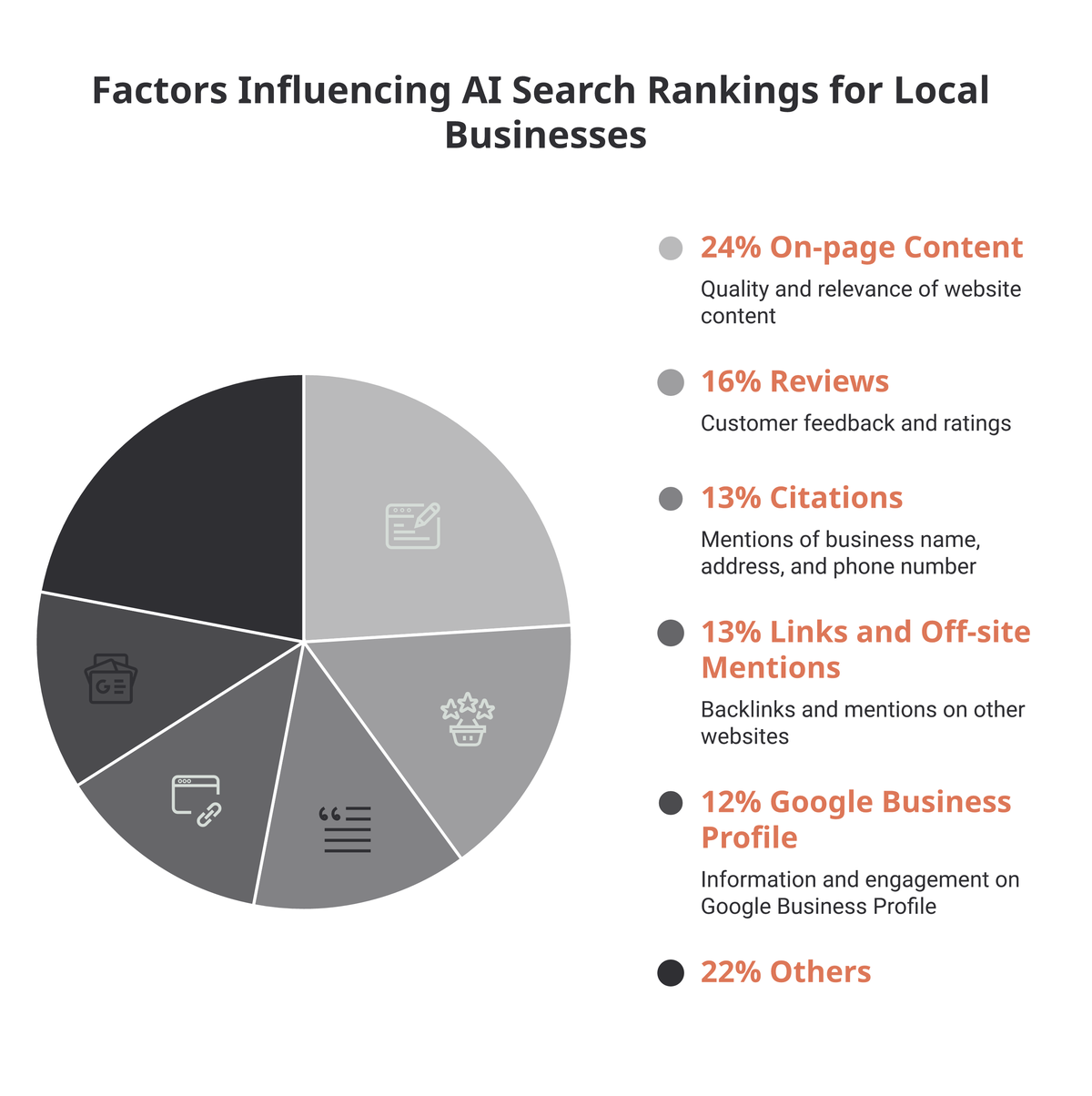
AI Search Factors
| Factor | Weight | Key Metric / Process |
|---|---|---|
| On-page | 24% | Content specificity and originality. |
| Reviews | 16% | Sentiment analysis from authentic customer perspectives. |
| Citations | 13% | Accurate entity information for AI systems to reference. |
| Links | 13% | Link equity; off-site mentions are also highly important. |
| Google Business Profile (GBP) | 12% | Accurate, complete, and verified entity data. |
| Personalization | 9% | Specific to the individual searcher. |
| Social | 9% | Social mentions and visibility. |
| Behavioral | 4% | User engagement metrics. |
My Take: What This Means for Solo Publishers
Most of what Gifford covers is aimed at brick-and-mortar businesses trying to dominate their local Map Pack — the dentist, the HVAC company, the car dealer. But if you’re running affiliate sites with geo-targeted pages, a lot of this translates more directly than you’d think.
The on-page signals are the ones that matter most for affiliates. Since you’re unlikely to have a Google Business Profile tied to a physical address, you’re working primarily with the localized organic algorithm — where on-page content sits at 33%. That means the specificity test Gifford describes is make-or-break. If your “best plumbers in Austin” page could be copy-pasted to “best plumbers in Denver” with a find-and-replace, it’s not passing the test. Real local specificity — actual neighborhood references, local pricing norms, locally relevant service details — is what differentiates ranking pages now. This connects directly to the context density framework that’s increasingly central to AI-era content rankings.
AI Overviews are now showing up in local search. Research confirms that Google’s AI Overviews have started appearing in a growing share of local search results in 2026 — which means your affiliate local pages face the same visibility risk as regular informational content. The AI search ranking factors table above is worth studying: citations (13%) and off-site mentions (13%) are both significant, and neither requires you to have a physical location. The “mention wheel” concept — local businesses cross-mentioning each other — is something affiliate publishers can adapt by building topical clusters and earning entity mentions rather than just links. The guide to adapting to AI search goes deeper on that shift.
Local link building is finally getting its due. Reviews are less actionable for affiliates (no customers leaving reviews), but local links are wide open — low-authority local sources like community pages, local directories, and regional news sites all carry real weight in the local algorithm. Nofollow links count too. If you’re building geo-targeted affiliate content, a systematic link building approach targeting local publications outperforms chasing generic DR60+ placements every time.
What to skip: GBP optimization, review management tactics, and UTM tracking on your GBP listing — none of that applies without a physical presence. The affiliate SEO strategy breakdown covers where to focus energy instead. And if you’re thinking about local SEO as one lever in a broader traffic mix, it fits neatly into the diversification playbook — geo-targeted content is one of the more durable traffic sources because it’s genuinely harder to replicate at scale with AI tooling.
The AI-Era Angle: From Top-3 Pin to Named Recommendation
Gifford’s framing assumes the goal is a position — one of three pins in the Map Pack. That goal is quietly being subsumed. When a searcher asks ChatGPT, Gemini, Google’s AI Mode, or Maps’ own AI summaries “best X near me,” the output increasingly isn’t a clickable three-pin pack — it’s a synthesized shortlist of named businesses with a sentence of justification each. The KPI moves the same way it has across every post in this reframe sweep: from rank in the top 3 to be the entity the model names. Local is just the version of get-cited instead of ranked where the citation is a recommendation.
The post’s own AI Search Factors table is the tell. In the classic Local Pack, GBP carries 32% — a single asset you control dominates, so the game is “fill out the profile better than the dentist down the street.” In the AI Search column, GBP drops to 12% and the weight flattens across on-page (24%), reviews (16%), citations (13%), and links/off-site mentions (13%). That flattening is the strategic shift: a model doesn’t read your profile and rank it, it triangulates your business as an entity across every independent source it can retrieve. You can’t fill out your way to the top of a recommendation — you have to be consistently legible everywhere the model reads. Gifford’s “mention wheel” stops being a brick-and-mortar reciprocity hack and becomes the core entity-building move: independent, corroborating mentions are exactly the signal a retriever uses to decide a business is real, relevant, and safe to name.
For the solo publishers this site is actually written for, that flattening is good news. Map-pack local was gated by a physical address — no storefront, no GBP, no pins, conversation over. AI local removes the gate. On-page specificity (24%), citations (13%), and off-site mentions (13%) add up to half the AI-search weight and none of them require a verified location. A geo-targeted affiliate page can be the source a model lifts a local recommendation from, even though it could never have placed in the Map Pack.
Which makes the specificity test from My Take sharper still. A retriever deduplicates: a “best plumbers in Austin” page it could regenerate from a find-and-replace template carries no new entity information, so it gets skipped in favor of a source that does. Real local detail — named neighborhoods, local pricing norms, the regulatory quirk that only applies in that metro — is no longer just a ranking nicety; it’s the thing that makes a passage worth extracting into an answer the model would otherwise write itself. In the AI era, the most replaceable local page is the one the model never needed you for.
Actionable Takeaways for Local SEO
Website Content Optimization
- Create Human-First Content: Optimization should target the user journey, recognizing customers rarely convert on their first visit, especially for high-cost items. Content must be memorable and distinctive.
- The Specificity Test: If your content would still work for a similar business in a different city with only name/location changes, it is not sufficiently specific to your local area.
- Page Structure: Have dedicated pages for specific search phrases, aiming to be the best local answer. Include geolocation phrases in title tags, H1s, and alt text.
- Blog Strategy: Focus on “pre-funnel content” (mid-to-upper funnel) about local information (e.g., local guides) to build local relevancy and brand awareness.
Google Business Profile (GBP) Management
- Crucial First Impression: GBP is the most influential factor in the Local Pack (32% weight).
- Configuration: Fill out all fields except “areas served” for brick-and-mortar locations. Add UTM tracking to the website link in the GBP to improve analytics attribution.
- Schema: Local business schema should only be on the landing page linked from the GBP (typically the homepage).
- Business Hours: Maintain accurate business hours, as Google’s “openness update” prioritizes open businesses in search results during relevant times.
Link Building and Off-Site Signals
- Local Link Value: Low authority links from highly local sources (e.g., local non-profits) are valuable in the local algorithm. Nofollow links still impact local rankings.
- AI Mentions: For AI search, off-site mentions without links are highly valuable. Implement a “mention wheel” where local businesses reciprocally mention each other to strengthen AI visibility.
Review Management
- Increasing Importance: Reviews account for 20% of Local Pack ranking and 16% of AI Search factors.
- Proactive Strategy: Proactively request reviews from satisfied customers and respond to all reviews (positive and negative). Craft negative review responses for the benefit of future customers.
- Advanced Tactic: To push negative reviews down the default sort order, encourage detailed positive reviews with photos and ask colleagues for upvotes.
- Content Insights: Use review content to improve website language, as it provides authentic customer perspectives.
Greg Gifford’s Local SEO Audit Tool
- Evaluation Areas: The proprietary “local SEO score” audit tool evaluates four key areas: website content optimization, inbound links, Google Business Profile optimization, and review management.
- Opportunity: The tool indicates the average score for businesses is only 18 out of 100, highlighting significant opportunity for improvement in local markets.
Sources: Greg Gifford’s local SEO presentation via SearchLab Digital; Local Search Ranking Factor Study. Related reading on RankingHacks: Context Density: The SEO Framework Built for AI-Driven Search, The New SEO Formula: Adapting to AI Search, Passive Link Building: The Data Study Autopilot System.