Context Density: The SEO Framework Built for AI-Driven Search
Rob Garner’s context density framework from the WorkHacker Podcast — a practical guide to writing for chunk-level AI retrieval, not keyword frequency.

Rob Garner — SEO veteran, author of Search and Social (McGraw-Hill), and host of the WorkHacker Podcast — has spent the last seven months building a case for what he calls “context density.” The core argument: keyword density is a relic of string-matching search. In a world where Google’s Gemini, ChatGPT, and Perplexity retrieve vector-embedded chunks — not pages — what matters is the semantic depth of every individual section you publish.
Across 35 episodes (featuring interviews with Bruce Clay and the original coiners of the term “SEO,” Bob Heyman and Viktor Grant), Garner builds a complete publishing framework. This post distills that framework into a practical guide — and attempts to practice what it preaches.
Keyword Density vs. Context Density: What Changed
For two decades, SEO revolved around a simple formula: find the right keyword, place it in the title tag and H1, repeat it at a target frequency, and signal relevance. Tools like Yoast and Surfer SEO still measure keyword density as a percentage. That metric worked when Google matched strings using TF-IDF.
It breaks down in an era of semantic search.
Google’s shift began with BERT (2019), accelerated through MUM (2021), and reached a tipping point with Search Generative Experience and Gemini integration. These systems evaluate meaning through transformer-based models that understand entities, relationships, co-occurrence patterns, and user intent — not term frequency.
Garner frames this as a fundamental reorientation. Keywords aren’t dead — they’re what he calls “axis points.” An axis point anchors a semantic field the same way a hub anchors a spoke wheel. But the keyword alone doesn’t define meaning. The environment around it does.
Here’s the difference in practice:
| Keyword Density | Context Density | |
|---|---|---|
| What it measures | Frequency of a target phrase | Semantic breadth and depth per section |
| Optimization unit | The page | The chunk (H2 section) |
| Signal to search | “This page mentions X often” | “This section thoroughly covers X’s meaning” |
| Entity handling | Keywords as strings | Keywords as axis points in entity networks |
| AI retrievability | Weak — repetition creates thin embeddings | Strong — diverse semantic signals create dense vectors |
| Failure mode | Keyword stuffing | Verbose filler that dilutes density |
| Tool measurement | Yoast, Surfer keyword % | NeuronWriter semantic score, Clearscope entity coverage |
The practical test: you can repeat “best mirrorless camera” ten times in a section and still produce something thin. If that section doesn’t expand the topic through sensor technology (BSI CMOS, stacked sensors), autofocus systems (phase-detect, subject tracking), lens mount ecosystems (Sony E, Canon RF, Nikon Z), and shooting scenarios (street photography, wildlife, studio), it lacks the semantic depth that both Google and LLMs need to consider it authoritative.
For a deeper look at how this plays out in LLM retrieval specifically, see our breakdown of the shift to topical coverage and information retrieval cost.
How LLMs Retrieve Chunks, Not Pages
Traditional search engines indexed pages and returned a ranked list of ten blue links. Large language models work differently: they retrieve chunks.
When an LLM-powered system (ChatGPT, Perplexity, Google’s AI Overviews) processes your content, it segments the page into smaller sections — roughly paragraph or heading-level blocks. Each chunk gets converted into a vector embedding: a high-dimensional mathematical representation that captures semantic relationships. These embeddings live in vector databases (FAISS, Pinecone, Weaviate) and get queried through retrieval-augmented generation (RAG) pipelines.
When a user submits a query, the system computes the query’s embedding and finds the chunks whose vectors are closest in semantic space. It retrieves those specific sections — not the full page.
This has a critical implication: chunk-level density matters more than page-level optimization.
A section that merely restates the axis term without expanding its semantic field becomes thin at the embedding layer. Thin vectors sit far from query vectors and get skipped. Dense sections — loaded with co-occurring terms, related entities, intent resolution, and problem framing — produce vectors that cluster near a wide range of relevant queries.
We covered the mechanics of this in detail in our post on optimizing for Google’s chunk-ranking paradigm, and you can see how RAG systems use this infrastructure in our piece on enterprise RAG-powered content generation.
What this means for your writing process:
Every H2 section should function as an independently retrievable unit. It should answer a specific question, incorporate relevant entities, and expand the semantic scope beyond the axis term. If a section only makes sense in the context of the full article — if it’s a transition paragraph or a vague lead-in — it’s structurally invisible to AI retrieval.
The self-audit question Garner recommends: “Does this section expand the semantic field, or does it simply repeat the axis term?” If it’s the latter, it needs reinforcement.
What Makes a Section “Dense”: The Four Layers
Context density isn’t about word count. Dense doesn’t mean long. Dense means meaningful. Garner identifies four layers that contribute to chunk-level density:
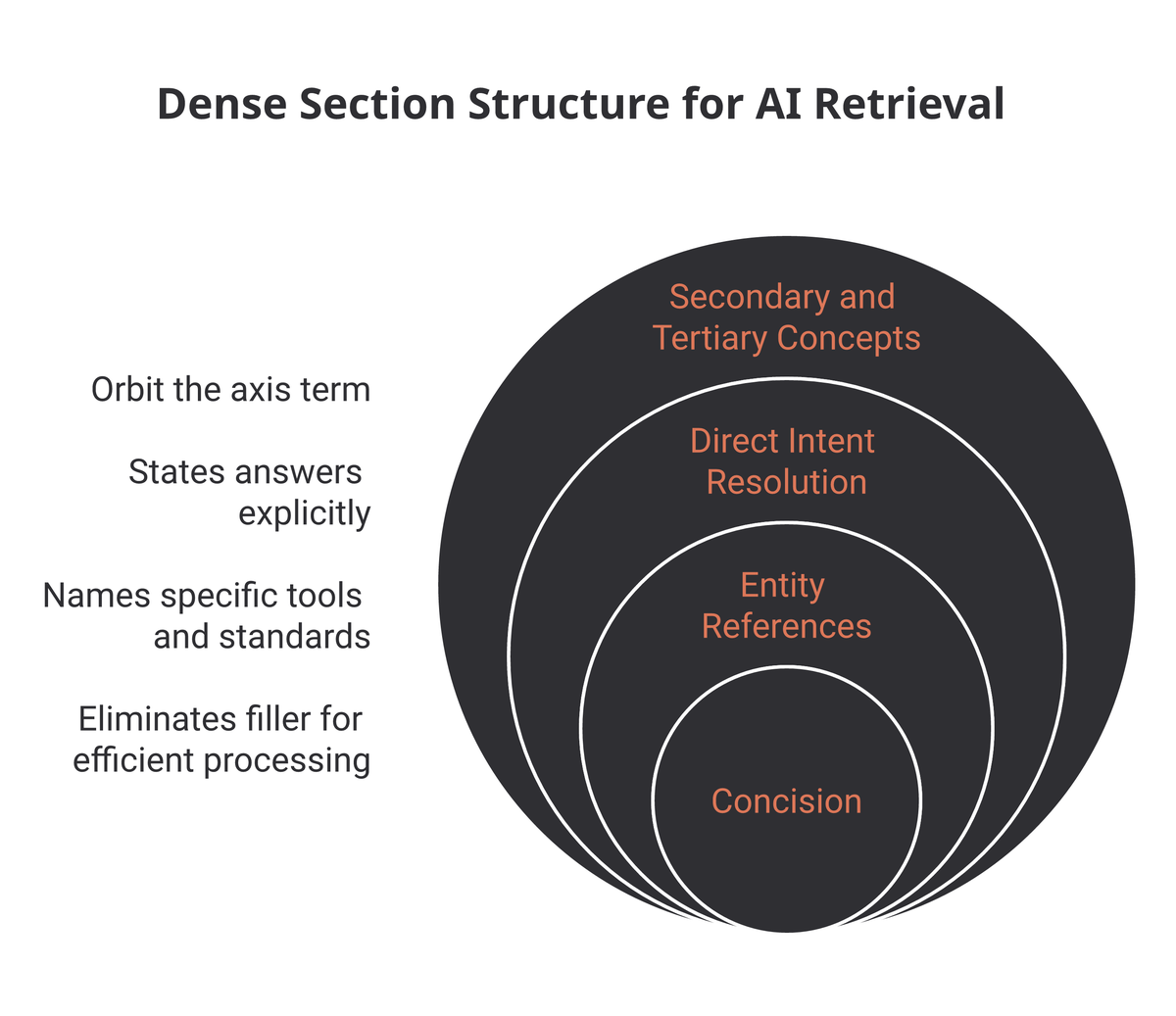
1. Secondary and Tertiary Concepts
Every topic has a primary axis term, but complete coverage requires the concepts that orbit it. For an article targeting “technical SEO audit,” the layers look like this:
- Primary axis: technical SEO audit
- Secondary concepts: crawl budget optimization, Core Web Vitals (LCP, FID, CLS), XML sitemap structure, robots.txt directives, canonical tag implementation, JavaScript rendering
- Tertiary concepts: log file analysis with Screaming Frog, Googlebot crawl frequency patterns, hreflang for international sites, orphan page detection, structured data validation via Google’s Rich Results Test
The secondary layer defines scope. The tertiary layer proves depth. Both strengthen the embedding.
Koray Tuğberk Gubur’s work on topical maps and Olesia Korobka’s research on ontological SEO provide complementary frameworks for mapping these concept layers systematically.
2. Direct Intent Resolution
Don’t imply what the user wants to know — resolve it explicitly. If someone searching “technical SEO audit” wants to know where to start, state the starting point. Sections that build suspense or dance around the answer get skipped by both readers and retrieval systems.
Before (thin): “There are many factors to consider when performing a technical SEO audit. The process can be complex and varies by site.”
After (dense): “Start a technical SEO audit with a Screaming Frog crawl of the full site. Export the results and filter for: HTTP status codes above 299, pages with missing canonical tags, duplicate title tags, and pages blocked by robots.txt that shouldn’t be. This surfaces the highest-impact issues in under 30 minutes.”
The second version resolves intent, names specific tools and actions, and stands alone as a retrievable answer.
3. Entity References
Entities formalize a topic’s boundaries. Mentioning Google Search Console, Screaming Frog, Ahrefs Site Audit, PageSpeed Insights, and Chrome DevTools in a technical SEO section tells both Google’s Knowledge Graph and LLM systems exactly what domain you’re operating in. Generic descriptions without named entities produce weaker embeddings.
4. Concision
This is counterintuitive for an industry that spent a decade chasing 3,000-word targets. But verbose prose dilutes density. If a paragraph wanders without adding semantic reinforcement, it weakens the embedding — the vector gets pulled toward “generic filler” rather than “authoritative coverage.”
Every sentence should earn its place. Filler doesn’t just bore readers — it mathematically weakens your chunk’s position in vector space.
Site Architecture as a Semantic Signal
Most SEOs treat site architecture as housekeeping: clean URLs, breadcrumbs, an XML sitemap. Garner argues it’s a semantic layer that AI systems actively interpret.
Where a page lives within your site communicates meaning. Taxonomy defines topical clusters. URL hierarchy signals scope and depth. Internal links declare relationships between concepts.
AI systems don’t just read pages — they read the relationships between pages. If your internal links consistently connect “technical SEO audit” to “Core Web Vitals optimization,” “crawl budget management,” and “structured data implementation,” you’re building a semantic map that reinforces each page’s authority in its cluster.
If those pages sit in unrelated categories with no linking between them, each one fights alone.
The architecture audit:
- Cluster check. Pull your sitemap into Screaming Frog or Ahrefs. Do related pages share a URL directory or category? Or are they scattered across unrelated sections?
- Internal link audit. For each pillar page, check: does it link to and receive links from its natural subtopic pages? Use Ahrefs’ Internal Link Opportunities report or Screaming Frog’s link analysis.
- Taxonomy review. Do your categories and tags reflect semantic groupings — or are they legacy organizational buckets that no longer match your content strategy?
- The AI test. If a crawler visited only your internal links (ignoring page content), would it correctly infer which topics you’re authoritative on?
Architecture isn’t an afterthought. It’s a reinforcing layer that multiplies the density of every page in the cluster.
Schema Markup: The Declarative Layer
Linguistic context builds meaning implicitly. Schema.org markup formalizes it explicitly.
Schema declares what something is in JSON-LD format — identifying entities, clarifying relationships, and eliminating ambiguity in a way that machines can parse without interpreting natural language.
In Garner’s framework, schema is the third pillar alongside writing and architecture:
- Linguistic signals (the words) build meaning implicitly
- Structural signals (architecture and internal links) build meaning through relationships
- Declarative signals (schema) formalize meaning so machines can confirm it without guessing
Practical implementation by content type:
| Content Type | Schema Types | Key Properties |
|---|---|---|
| Expert article | Article, Person (author), Organization | author.sameAs, dateModified, about |
| How-to guide | HowTo, Step | tool, supply, estimatedCost, totalTime |
| Product review | Review, Product, AggregateRating | brand, offers, ratingValue |
| Comparison post | ItemList, Product | itemListElement, individual product schemas |
| Interview/podcast | PodcastEpisode, Person | partOfSeries, duration, associatedMedia |
When all three layers align around a clear topical axis, you create what Garner calls a “cohesive semantic environment.” Each layer reinforces the others. Schema isn’t decoration — it’s structural reinforcement that confirms what your content implies.
For more on how Google’s systems use structured data in ranking and retrieval, see our analysis of Google’s ranking mechanisms from patents and API documentation.
Soft Signals: Brand Mentions as Authority
Traditional link building assumes authority flows through hyperlinks. Garner has argued since 2013 (in Search and Social) that brand mentions — unlinked references to a brand, person, or product — carry independent authority signals.
In 2025–26, this is no longer theoretical. Google’s patents reference “implied links” (co-citations without hyperlinks). LLMs like ChatGPT and Perplexity build entity associations from training corpora where most references are unlinked text, not hyperlinks.
When multiple authoritative sources mention your brand in the context of a specific topic — even without linking — AI systems register that co-occurrence pattern as a trust signal. Digital PR that secures tier-one media mentions feeds the knowledge layer that LLMs reference. Those mentions persist in training data longer than PBN links or mass-produced guest posts.
What to do:
- Track unlinked brand mentions with Ahrefs Alerts or Google Alerts alongside traditional backlink monitoring
- Evaluate Digital PR campaigns by mention quality and contextual relevance, not just link acquisition
- Monitor your brand’s appearance in LLM answers (ask ChatGPT, Perplexity, and Gemini about your topic — are you cited?)
- Build entity associations through consistent, authoritative coverage of your core topics across multiple channels
The point isn’t to abandon link building. It’s to recognize that in AI-driven discovery, the definition of “authority signal” has expanded beyond the hyperlink. Our link building strategies analysis covers the traditional side; Garner’s framework adds the contextual mention layer.
SERP Analysis for Competitive Context Modeling
Most SEOs analyze SERPs to find keywords. Garner analyzes SERPs to reverse-engineer the semantic boundaries of a topic.
The method: examine the top 10 results for a target topic — not to copy them, but to identify what search systems collectively recognize as “complete coverage.”
The SERP analysis workflow:
- Pull the top 10 results for your target query in Ahrefs, Semrush, or manually in an incognito browser.
- Map shared vocabulary. Which non-obvious terms appear across 7+ of the 10 results? These are core to the topic’s semantic field — not optional subtopics.
- Identify entity patterns. Which specific brands, tools, people, standards, or regulations do top results consistently reference? Missing entities = contextual gaps.
- Catalog modifiers. What qualifiers sharpen intent across results? (“for beginners,” “enterprise,” “in 2026,” “free,” “vs.”) These indicate subtopics that users expect.
- List consistently addressed questions. What problems or decisions does every strong result resolve? If all 10 address pricing and you don’t, that’s a semantic gap regardless of your keyword density.
The strategic question shifts from “What keyword should I target?” to “What defines this topic at a competitive semantic level?”
This isn’t about copying competitors. It’s about understanding what AI systems have learned to associate with complete topical coverage — then ensuring you meet or exceed that bar.
Tools like NeuronWriter, Surfer SEO’s Content Editor, and Clearscope automate parts of this analysis by showing entity coverage and semantic completeness scores.
Capturing Long-Tail Queries Through Coverage, Not Targeting
Traditional SEO created separate pages for every keyword variation. The context-density model inverts this: build one dense semantic environment that captures related queries naturally.
Stemmed and fanned-out searches — “how much does a technical SEO audit cost,” “technical SEO audit checklist for ecommerce,” “best technical SEO audit tools 2026” — share a conceptual root with the primary topic. You capture them not by creating individual pages for each, but by covering the full semantic field so thoroughly that your content is contextually eligible for all of them.
Garner calls this the shift from “precision targeting to contextual eligibility.”
Practical application:
Instead of creating 10 thin pages for 10 long-tail keyword variations, create one dense pillar page that addresses:
- The core concept (what, why)
- The process (how, step-by-step)
- The tools (named entities: Screaming Frog, Ahrefs, GSC)
- The cost and time investment
- Common mistakes and edge cases
- Comparisons and alternatives
That single page produces dense vectors across multiple query intents. It will be more retrievable, more authoritative, and more resilient to algorithm changes than a cluster of 300-word pages targeting individual variations.
For more on this approach, see our coverage of the technical framework for LLM content optimization.
Why Most AI Content Fails — And the Assembly Line Fix
AI content tools have flooded the web with generated text. Most of it underperforms. Garner identifies three failure patterns — all strategic, not technical:
1. Generic output. LLMs optimize for statistical probability, producing the most average version of whatever you prompt. The result sounds polished but empty — lacking the named entities, specific data points, and original framing that signal real expertise. As we noted in our analysis of how to build authority with AI content, generic AI content gets outranked by content that demonstrates first-hand experience and specific knowledge.
2. Structural confusion. AI text may read fine sentence by sentence but often buries main ideas, leaves logic loops unresolved, and misaligns headings with user queries. Both chunk-level retrieval and human readers struggle with disorganized content.
3. Misplaced intent. Content created to fill a keyword gap ignores what users actually need. No amount of generation quality compensates for a flawed premise.
The fix — Garner’s “content assembly line”:
- Modular creation. Break content into reusable components: intros, data sections, expert commentary, summaries. Generate each separately with focused prompts.
- Human checkpoints. Review each module for accuracy, brand voice, and entity correctness before assembly. AI is the first draft, not the final product.
- Systemized quality metrics. Define measurable standards (entity coverage, readability score, section independence) rather than relying on subjective “does this sound good?”
- Iterate before publishing. Re-prompt sections that are thin. Add specific entities, data, and examples. Treat generation as staged conversation: plan → draft → reinforce → tighten.
The key quote from the podcast: “A disciplined system transforms automation into an advantage; a reckless one just amplifies inefficiency.”
My Take: What This Means for Solo Publishers
The 48% AI Overviews coverage number (March 2026, per multiple tracking studies) is the stat that changed how I think about this framework. Nearly half of all Google queries now route through an AI layer that’s pulling chunks, not blue links. For solo affiliate publishers, that’s not a distant future — it’s the search results your readers see right now.
Here’s what I’d actually implement from Garner’s framework, in priority order:
Start with your H2 sections, not your pages. The chunk-first insight is the practical core of context density. Go to your highest-traffic posts and read each H2 section in isolation. Does it stand alone? Does it name specific entities — tools, brands, processes — rather than describing them generically? If you pulled that section out of context and fed it to ChatGPT, would it generate a coherent answer? If not, that’s the edit. I’ve covered the mechanics of what actually gets retrieved in Steve Toth’s LLM content optimization framework.
Add 5–7 specific statistics per section. AirOps data from April 2026 shows content with 5–7 statistics earns 20% higher AI citation likelihood. For affiliate content, this is actionable today — product specs, price comparisons, survey data. The specificity matters more than the volume.
Comparison tables are worth the effort. Comparison pages with 3 tables earn 25.7% more ChatGPT citations (AirOps, April 2026). For affiliate roundups and product comparisons, this is a direct optimization lever — it improves both traditional SERP performance and AI citation rates simultaneously. AI Chatbot Optimization: Ranking Strategies for LLMs maps out the broader citation-building picture.
Skip the schema rabbit hole for now. Schema is the third pillar in Garner’s framework, but for solo publishers it’s the last priority. Get your H2 entity density and section independence right first. Thin, verbose H2 sections won’t be rescued by structured data — fix the writing before adding the markup.
GEO auditing is worth doing. I ran a GEO audit on my own sites and found Perplexity already citing my content at a 59/100 GEO score — without deliberately optimizing for it. That’s the compounding effect of chunk-density work already in place. Track your AI citation footprint now, before it’s crowded.
The context-density model isn’t a one-time audit — it’s a writing discipline. Operators building it into their process now are accumulating a structural advantage that compounds as AI Overviews expand their query coverage. For the full strategic picture, The New SEO Formula: Adapting to AI Search covers the adjacent terrain worth reading alongside this framework.
The Context Density Checklist: Applying the Framework
Garner’s final podcast episode synthesizes the full series into a step-by-step publishing framework. Here’s the actionable version:
Step 1: Map the semantic field before writing.
Define the primary axis term. Use NeuronWriter, Surfer, or manual SERP analysis to identify secondary concepts (scope-defining), tertiary concepts (depth-proving), and required entities. Don’t start writing until you can list 15–20 terms that define complete coverage.
Step 2: Write each section as an independent retrievable unit.
Every H2 should answer a specific question, name relevant entities, and resolve user intent. Test: could an LLM pull this section alone into a coherent answer?
Step 3: Audit for density, not length.
Read each paragraph and ask: does this sentence add a new concept, entity, or intent signal? If it restates what’s already been said or pads the word count, cut it. Run the page through Clearscope or NeuronWriter to check entity coverage scores.
Step 4: Reinforce through architecture.
Link this page to and from related content on your site. Ensure it sits in the correct topical cluster. Verify that your taxonomy and URL structure reflect semantic relationships.
Step 5: Add schema markup.
Implement JSON-LD schema appropriate to the content type (Article, HowTo, FAQ, Review). Declare author entities with sameAs links to authoritative profiles. Validate with Google’s Rich Results Test.
Step 6: Run competitive context analysis.
Compare your finished content against the top 10 SERP results. Identify any entities, subtopics, or intent angles they consistently cover that you’ve missed. Fill the gaps.
Step 7: Test dual-purpose retrievability.
Your content now serves two systems: traditional search (Google index) and AI retrieval (LLM chunk selection). Ask ChatGPT or Perplexity a question your content should answer. If your content isn’t surfaced or synthesized, identify which sections lack the density to compete.
Who Is Rob Garner?
Rob Garner is the Chief Strategist at WorkHacker Digital and author of Search and Social: The Definitive Guide to Real-Time Content Marketing (McGraw-Hill). He has worked in search since the industry’s earliest days and is a recognized voice on the intersection of SEO, AI, and content strategy.
The WorkHacker Podcast — subtitled “Agentic SEO, GEO, AEO, and AIO Workflow” — launched in September 2025 on Podbean, Apple Podcasts, Spotify, and Amazon Music. Across 35 episodes, Garner builds the context-density framework progressively: from foundational concepts (the etymology of “SEO,” brand mentions as ranking signals, site architecture as meaning) through technical mechanics (vector databases, RAG retrieval, schema modeling) to a complete publishing framework.
Notable episodes include interviews with Bruce Clay (one of the original SEO practitioners, founder of Bruce Clay Inc.) and Bob Heyman and Viktor Grant (widely credited with coining the term “Search Engine Optimization” in the mid-1990s). An episode on ElevenLabs voice cloning revealed that 10 of the podcast’s first 12 episodes used a premium AI voice clone — a fact most listeners didn’t detect.
The full podcast is available at workhacker.podbean.com.
Frequently asked questions
What is context density in SEO?
Context density is Rob Garner’s framework for writing to the semantic depth of each individual section rather than the frequency of a target keyword. The argument is that keyword density was built for string-matching search, while systems like Gemini, ChatGPT, and Perplexity retrieve vector-embedded chunks — so what matters is how thoroughly each section covers its topic’s meaning. In this model keywords aren’t repeated for their own sake; they act as “axis points” that anchor a semantic field.
How is context density different from keyword density?
Keyword density measures how often a target phrase appears on a page, while context density measures the semantic breadth and depth of each H2 section. The optimization unit shifts from the page to the chunk, and the failure mode shifts from keyword stuffing to verbose filler that dilutes density. You can repeat a phrase ten times in a section and still produce something thin if it doesn’t expand the topic through related concepts, entities, and scenarios.
Why do AI search engines retrieve chunks instead of whole pages?
LLM-powered systems segment a page into smaller heading- or paragraph-level blocks, convert each into a vector embedding, and store them in vector databases queried through retrieval-augmented generation. When a user asks a question, the system finds the chunks whose vectors sit closest in semantic space and retrieves those specific sections, not the full page. This is why chunk-level density matters more than page-level optimization: thin sections produce thin vectors that get skipped.
What makes an H2 section dense enough to be retrieved by AI?
Garner identifies four layers: secondary and tertiary concepts that orbit the axis term, direct intent resolution that states answers explicitly, entity references that name specific tools and standards, and concision that cuts filler. Density isn’t about word count — dense means meaningful, not long. A useful self-audit is whether a section expands the semantic field or simply repeats the axis term.
Sources: WorkHacker Podcast by Rob Garner (Episodes 1–35, September 2025 – April 2026); AirOps AI Citation Study (April 2026); DigitalApplied.com SEO After AI Overviews Guide (2026). Related reading on RankingHacks: LLM-Driven SEO, Chunk-Ranking Paradigm, RAG-Powered Content Systems, Topical Maps, LLM Content Optimization, GEO Audit.