What Is GEO? Answer-Engine Optimization, Explained
GEO — generative engine optimization, also called answer-engine optimization (AEO) — is the practice of getting your pages cited inside AI answers, not just ranked on a results page. Here's the working definition, how answer engines actually pick their sources, and what a solo publisher should do about it.

For fifteen years the job was to rank. You wrote a page, it landed somewhere in ten blue links, and the click was the prize. That model is quietly being replaced. A growing share of searches now end inside an AI answer — Google’s AI Overviews, ChatGPT, Perplexity, Claude, Gemini — where a model reads a handful of sources, synthesizes them into a paragraph, and the user never visits a site at all. The new question isn’t where do I rank? It’s does the answer quote me?
That is what GEO is about. This page is the working definition and the field map — the hub the rest of the AI Search · GEO channel hangs off.
What is GEO?
GEO (generative engine optimization) is the practice of structuring a site and its content so that AI answer engines retrieve, trust, and cite it when they generate responses. The goal is inclusion in the answer — being one of the sources a model quotes or links — rather than position on a classical results page.
You’ll see the same idea under a second name: AEO (answer-engine optimization). In practice the two terms describe the same work. GEO leans toward the generative surface (the synthesized paragraph); AEO leans toward the answer (the cited source). This site uses them interchangeably and won’t pretend there’s a meaningful technical line between them.
One honest caveat up front: Google itself rejects the premise that GEO is a separate discipline. Its May 2026 AI optimization guide says, in as many words, that “optimizing for generative AI search is optimizing for the search experience, and thus still SEO.” That’s worth taking seriously — and we’ll come back to where Google is right and where it’s being convenient.
GEO vs. AEO vs. SEO
| What it optimizes for | The win condition | Primary surface | |
|---|---|---|---|
| SEO | Ranking on a results page | A high position + a click | Ten blue links |
| GEO | Being retrieved and synthesized by a model | Inclusion in the generated answer | AI Overviews, ChatGPT, Perplexity |
| AEO | Being named as the cited source | A citation / link inside the answer | The “sources” row under an AI answer |
The rows overlap more than the marketing around them suggests. A page that can’t be indexed and isn’t snippet-eligible in classical Search is also invisible to AI Overviews, because — per Google — the AI surfaces run on the same core ranking index. So GEO is not a parallel track you build instead of SEO. It’s a layer you add on top of a technically sound, well-ranked page.
How an answer engine actually picks its sources
You can’t optimize for a black box you don’t understand, so here’s the mechanism in plain terms. Three pieces matter.
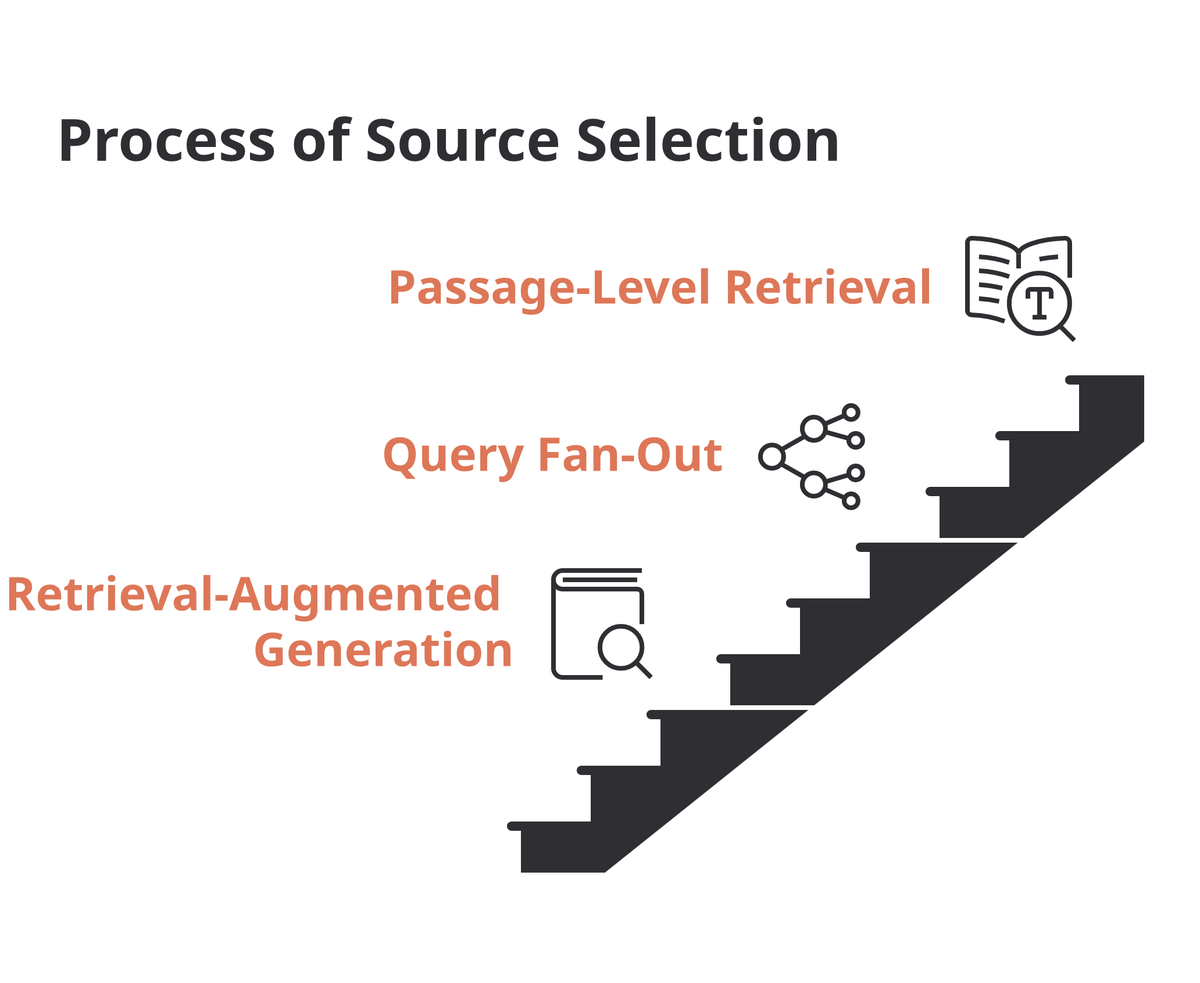
Retrieval-augmented generation (RAG). When you ask an AI engine a question, it doesn’t answer purely from training memory. It runs a live search, pulls back a set of relevant pages, and grounds its answer in them. Grounding is what keeps the model from hallucinating — and the pages it grounds on are the pages that get cited. Google confirmed RAG uses its existing Search index; the deeper mechanics are unpacked in the Cyrus Shepard breakdown of Google’s search mechanisms.
Query fan-out. A single user prompt rarely becomes a single search. The model expands it into a fan of related sub-queries and retrieves results for each. A page that satisfies a wider net of related questions gets pulled into more of those sub-searches — which is the real mechanic underneath the “topical coverage beats keyword targeting” advice in LLM-driven SEO.
Passage-level retrieval. RAG operates on passages, not whole pages. The engine lifts the specific section that answers the question. That’s why a self-contained, topically dense H2 block outperforms the same information smeared across a wall of text — the chunker has a clean unit to extract. This is the core of the context-density framework and the chunk-ranking paradigm.
Put together: the engine fans your query into many, retrieves passages from its index, and grounds an answer on the ones that resolve cleanly. GEO is the work of making your passages the ones it reaches for.
What actually moves the needle (and what doesn’t)
Here’s where honesty matters more than hype. A lot of what’s been sold as GEO since late 2024 — special files, AI-only markup, bought “mentions” — Google explicitly says you don’t need. The full breakdown of Google’s mythbusting is worth reading, but the short version is that the unique surface area of GEO is smaller than the consultants selling it would like.
What does hold up:
- Originality the model can’t synthesize without you. If your page just recombines the top ten results, the engine recombines them itself and skips your link. Primary data, a real opinion, a first-hand test — that’s what gets cited.
- Clean, self-contained sections. Each H2 should answer one question fully. Not because a vendor says “chunk your content,” but because passage retrieval rewards blocks that stand alone.
- Entity clarity. The engine has to know who you are and what this page is about with no ambiguity. Resolvable entities, consistent authorship, and the EEAT signals covered in auditing EEAT with LLMs are what move a source from “retrieved” to “trusted.”
- Extractable answers. Front-load the answer. A direct, quotable sentence near the top of a section is the unit a model lifts. Burying the conclusion in paragraph four costs you the citation.
- Technical eligibility. Indexed, server-rendered, fast, snippet-eligible. If classical Search can’t surface the page, no AI surface can either.
What to stop doing: chasing llms.txt as a ranking lever, bolting on speculative AI-specific schema, and buying scattershot brand mentions. Those were the easy-to-sell parts of GEO, and they’re the parts that didn’t survive contact with Google’s documentation.
The RankingHacks position
GEO is real, but it’s narrower than its marketing and closer to SEO than its evangelists admit. The honest read sits between Google’s “do nothing different” and the industry’s “rebuild your whole site.” There are no magic files and no secret markup — but there is a content-quality bar that crept up: sections that stand alone, entities that resolve, answers that are quotable, originality a model can’t fake. That bar happens to overlap heavily with good SEO, which is exactly why the name RankingHacks still fits even as its meaning shifts from “rank #1” to “get cited.”
We’re not theorizing about this from the outside. We ran the GEO audit on this very site — scored 59/100, found Perplexity already citing us, and published the gaps. Eating our own dog food is the whole point.
Start here: the GEO cluster
If you’re working through this in order, these are the posts that build on the definition above:
- The practitioners worth studying — Kyle Roof: SEO strategies for the AI era · Koray Tuğberk Gübür’s topical maps — the two deep-dives the answer engines cite most often when they reach for RankingHacks
- The mechanics — Adapting to AI Search · LLM-Driven SEO: topical coverage & retrieval cost · Steve Toth’s LLM content optimization framework
- The content craft — Context Density · Optimizing for Google’s Chunk-Ranking Paradigm · AI Chatbot Optimization: ranking strategies for LLMs
- Trust & measurement — Auditing EEAT with LLMs · Lighthouse’s Agentic Browsing Score
- The reality check — Google’s AI Optimization Guide: It’s Still Just SEO · GEO Audit on My Own Site
Frequently asked questions
What is GEO?
GEO (generative engine optimization) is the practice of structuring a site and its content so that AI answer engines retrieve, trust, and cite it when they generate responses. The goal is inclusion in the answer — being one of the sources a model quotes or links — rather than a position on a classical results page. In short, the question shifts from “where do I rank?” to “does the answer quote me?”
What is the difference between GEO and AEO?
In practice they describe the same work. GEO leans toward the generative surface — the synthesized paragraph — while AEO (answer-engine optimization) leans toward the answer itself, the cited source. This site uses the two terms interchangeably and doesn’t pretend there’s a meaningful technical line between them.
Is GEO different from SEO?
Not by much. Google rejects the premise that GEO is a separate discipline, arguing that optimizing for generative AI search is still SEO. Because the AI surfaces run on the same core ranking index, a page that can’t be indexed or isn’t snippet-eligible in classical Search is invisible to AI Overviews too. So GEO is a layer you add on top of a technically sound, well-ranked page, not a parallel track you build instead of it.
How does an answer engine pick which sources to cite?
It grounds its answer in a live search rather than pure training memory — retrieval-augmented generation (RAG) — then fans a single prompt into many related sub-queries and lifts the specific passage that resolves each one. Pages that satisfy a wider net of related questions, and that offer clean, self-contained passages, get pulled into more of those sub-searches. GEO is the work of making your passages the ones it reaches for.
GEO is a moving target — these definitions reflect how the major answer engines behave as of mid-2026. Sources and related reading: Google’s generative AI optimization guide, and the RankingHacks AI Search · GEO channel.