Kyle Roof: SEO Strategies for the AI Era
Kyle Roof, an expert in empirical SEO testing, presented a detailed analysis affirming that while AI is a significant new layer, the core principles of search engine optimization remain largely unchanged. He positioned modern AI tools as a “Mechanical Turk”—powerful but requiring human expertise to

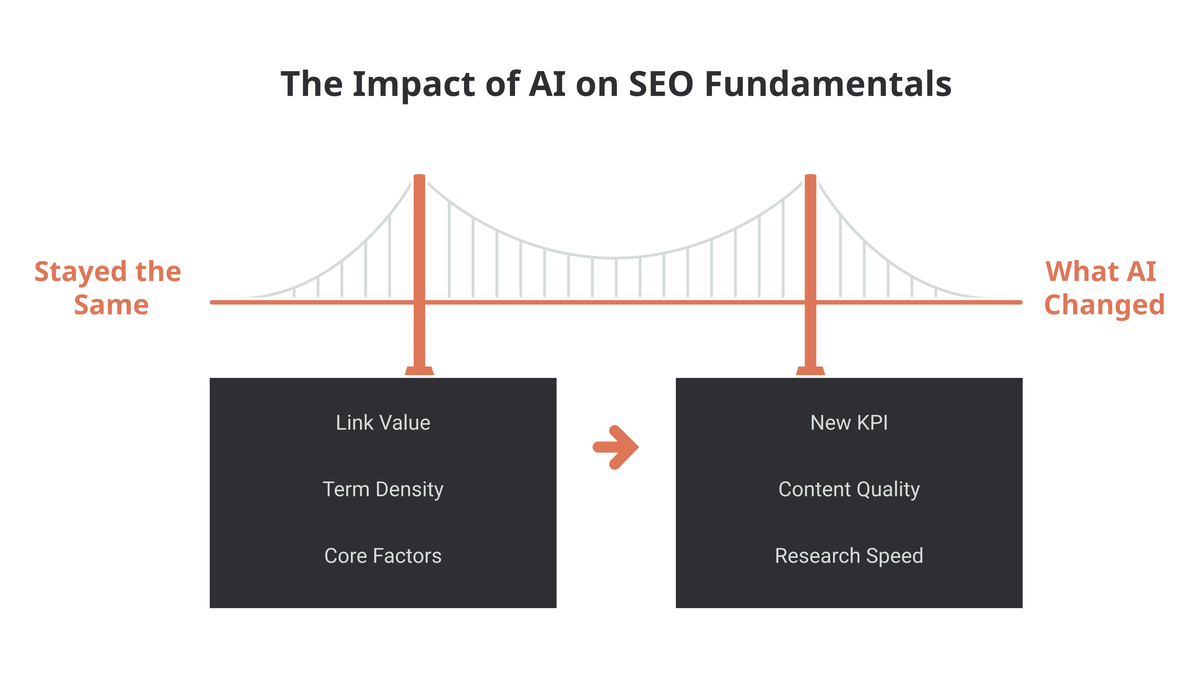
Kyle Roof, an expert in empirical SEO testing, presented a detailed analysis affirming that while AI is a significant new layer, the core principles of search engine optimization remain largely unchanged. He positioned modern AI tools as a “Mechanical Turk”—powerful but requiring human expertise to achieve optimal SEO performance. His presentation provided data on LLM content performance, essential ranking metrics, and actionable strategies for navigating the evolving search landscape.
Key Testing Insights and Core SEO Truths
Controlled Testing Methodology
The speaker’s approach, which led to a U.S. patent (explored in detail in his earlier SEO Revelations talk), involves creating identical pages for fake keywords and modifying a single element to isolate and determine ranking factors.
- Rhinoplasty Plano Test: The famous experiment demonstrated that a page written in Lorem Ipsum could rank by mathematically inserting the target keyword and contextual terms at the right densities. This ultimately triggered a Google policy update against non-sensical, keyword-stuffed text.
- Continued Validation: Subsequent tests, including those five years later, confirmed that core algorithm factors persist.
- Schema Markup is still not a ranking factor.
- Links remain effective for improving rankings, contradicting the claim that “links are dead.”
LLM Content Performance Analysis
Comprehensive testing of major Large Language Models (LLMs) revealed significant deficits in content generated without expert optimization. (For a deeper technical dive into optimizing LLM outputs, see Steve Toth’s framework for optimizing LLM outputs.)
| Model Output Metric | Baseline Prompt (No SEO Instructions) | SEO Requirements | Follow-up Status (End of Sept) |
|---|---|---|---|
| POP Score | Best around mid-60s | Target > 80% | No meaningful improvement |
| Word Count | Only 3 models met 1,000 words; others under-delivered | Target > 1,000$ words | Word counts dropped with “SEO Optimized” prompt |
| Readability | College-level across models | Target = 7th grade | Worsened with “SEO Optimized” prompt |
| Contextual Terms | Top performers delivered approx 53 terms | Needed approx. 200 terms | Decreased with “SEO Optimized” prompt |
Conclusion: Out-of-the-box LLM content fails to meet minimum SEO requirements for search engine comprehension and ranking. LLMs are tools that require human experts to define objectives and refine outputs.
Actionable Strategies for AI Search Engines
Keyword Selection and Filtering
Effective keyword selection is key to ranking within a site’s existing authority level.
- Tier-Based Filtering (Chris Carter’s Method):
- Determine your site’s “tier” level using your average daily click rate over three months (e.g., approx. 30 daily clicks = approx. Tier 20).
- Target Monthly Search Volume (MSV) ranges that align with your tier (e.g., approx. 20-50 MSV).
Keyword Golden Ratio (KGR): Use the KGR formula, often calculated as:
The speaker suggests using the KGR heuristic (+1) combined with an Ahrefs filter for “medium or better” competitiveness to validate keyword viability. The goal is to identify keywords that can be ranked with minimal on-page optimization (term in URL, title, H1, and one body mention).
- Keyword Golden Ratio (KGR): Use the KGR formula, often calculated as:
KGR =
Number of competing pages in Google’s title index
divided by
Monthly Search Volume
- Goal: Identify keywords that can be ranked with minimal on-page optimization (term in URL, title, H1, and one body mention).
Site Structure and Interlinking
A Reverse Silo interlinking strategy can be used to push target pages to top positions and achieve LLM sourcing. This pairs well with topical map strategies for building comprehensive authority.
- Process: Build supporting pages clustered around a target page.
- Interlinking: Interlink within the body content exclusively among cluster pages, transferring authority to the target page and facilitating LLM insertion.
Tracking and Measurement
AI introduces new Key Performance Indicators (KPIs) that must be tracked — a theme we covered in depth in The New SEO Formula: Adapting to AI Search.
- AI Overview Clicks: Google appends a specific URL tag for AI Overview traffic. Implement a custom script in Google Analytics to capture and analyze this click data.
- Keyword Scoring: Use AI tools to accelerate keyword research, reducing manual time from ~15 hours to ~2 hours by combining keyword scoring with topical clustering.
Domain Strategy
Classic strategies, such as Exact Match Domains (EMDs), are revived with modern TLDs.
- Descriptive TLDs (e.g., .club, .agency) rank generally as well as traditional TLDs.
- They provide new opportunities for EMDs and partial-match configurations, leveraging the TLD for descriptive alignment.
My Take
As a solo publisher running affiliate sites, Kyle’s presentation hit close to home. The core message — that AI doesn’t replace SEO fundamentals, it layers on top of them — is something I’ve seen firsthand. I’ve tested LLM-generated content on my own sites, and the data matches Kyle’s findings: raw AI output consistently underperforms on contextual term density and readability targets. You still need to know what “good” looks like before you can prompt for it.
The tier-based keyword filtering method is gold for smaller publishers. Most keyword research advice assumes you’re working with a DR 50+ site and a team. Kyle’s approach of matching your MSV targets to your actual traffic tier is practical and honest — it’s how solo operators avoid wasting months targeting keywords they can’t win.
One thing I’d push back on slightly: the Reverse Silo strategy works beautifully in theory, but for a one-person operation, building enough supporting content to create a real cluster takes time. My approach has been to prioritize depth over breadth — write fewer, more comprehensive pieces rather than a dozen thin supporting posts. That said, Kyle’s data on interlinking effectiveness is hard to argue with, and it’s made me rethink my own linking structure.
The EMD + descriptive TLD angle is underrated. I’ve been watching .club, .tools, and similar TLDs for new project opportunities, and Kyle’s confirmation that they rank comparably to .com is encouraging for anyone looking to start fresh in a niche without paying domain aftermarket prices.
Final Action Items by Kyle Roof
- Evaluate your current site tier using three-month click averages and align your target MSV ranges accordingly.
- Filter keywords using a combination of the KGR (+1) methodology and the Ahrefs “medium or better” threshold for competitiveness.
- Construct topical clusters and implement a Reverse Silo structure, using body content links only to interlink supporting pages to your target page.
- Implement GA tracking for AI Overview clicks using the identified Google URL tag and a custom script.
- Audit AI-generated content and augment it with expert keyword/contextual term insertion to meet the required mid-range density.
- Explore descriptive TLD and EMD opportunities for new projects to gain a ranking advantage.
Frequently Asked Questions
Does AI change the fundamentals of SEO, according to Kyle Roof?
According to Kyle Roof, AI does not replace SEO fundamentals — it layers on top of them. His empirical testing affirms that core ranking principles remain largely unchanged, with links still effective and schema markup still not a ranking factor. Roof frames AI tools as a “Mechanical Turk”: powerful, but reliant on human experts to define objectives and refine outputs to meet SEO requirements.
Why does out-of-the-box LLM content underperform on SEO metrics?
Out-of-the-box LLM content fails to meet minimum SEO requirements because raw model output falls short on key metrics. In Roof’s testing, baseline POP scores peaked in the mid-60s against a target above 80%, contextual terms reached only about 53 versus the roughly 200 needed, and readability stayed at college level rather than the 7th-grade target. Adding an “SEO Optimized” prompt actually worsened word count, readability, and term counts.
What is tier-based keyword filtering and why does it help small publishers?
Tier-based keyword filtering, attributed to Chris Carter’s method, matches your keyword targets to your site’s actual authority level. You determine your site’s “tier” from your average daily clicks over three months (about 30 daily clicks maps to roughly Tier 20), then target Monthly Search Volume ranges that fit that tier (such as 20-50 MSV). This helps solo publishers avoid wasting months chasing keywords they cannot realistically win.
How does Kyle Roof’s approach connect SEO to AI search visibility?
Kyle Roof’s approach treats AI search as an extension of strong SEO rather than a separate discipline, which aligns with the practice of generative engine optimization. He recommends a Reverse Silo interlinking structure to push target pages up and facilitate LLM sourcing, and he flags new KPIs to track — including AI Overview clicks, which Google tags with a specific URL parameter that can be captured via a custom Google Analytics script.