What Google's Open Knowledge Format Means for Small Publishers
Google Cloud just published the Open Knowledge Format — a way to store knowledge as a folder of linked markdown files for AI agents. The SEO crowd is already calling it the next llms.txt. It isn't, and the gap between what OKF actually is and what it's being sold as is the useful part for a solo publisher.

On June 12, Google Cloud published the Open Knowledge Format (OKF), and within a day the SEO timeline had already decided it was the next llms.txt — the new file you must add to your site or get left behind. It isn’t. OKF wasn’t built for your website, it doesn’t mention public web content anywhere in the announcement, and there is nothing to “implement” for rankings. But the gap between what OKF is and what it’s being sold as is exactly the thing worth understanding, because the direction underneath it is real and it’s the same direction this site keeps pointing at.
So let’s do the unglamorous version: what it actually is, what it is not, and the one lesson a solo publisher should take from it.
What OKF actually is
OKF is a way to represent a body of knowledge as a directory of markdown files. Each concept — a metric definition, a database table, a runbook, an API — gets its own markdown document. A thin block of YAML frontmatter at the top carries the structured fields (a required type, plus optional title, description, resource, tags, timestamp), the markdown body underneath carries the human explanation, and documents reference each other with ordinary markdown links. Those links are the trick: they turn a flat folder into what Google calls “a graph of relationships.”
That’s the whole thing. Google describes a bundle in three phrases — just markdown, just files, just YAML frontmatter. No runtime, no SDK, no build step, no proprietary platform. It renders on GitHub, ships as a tarball, mounts on any filesystem. If you’ve used Obsidian, Notion, or a Hugo content folder, the shape is instantly familiar; OKF just formalizes the conventions so a knowledge base written by one tool can be read by a different AI agent without translation.
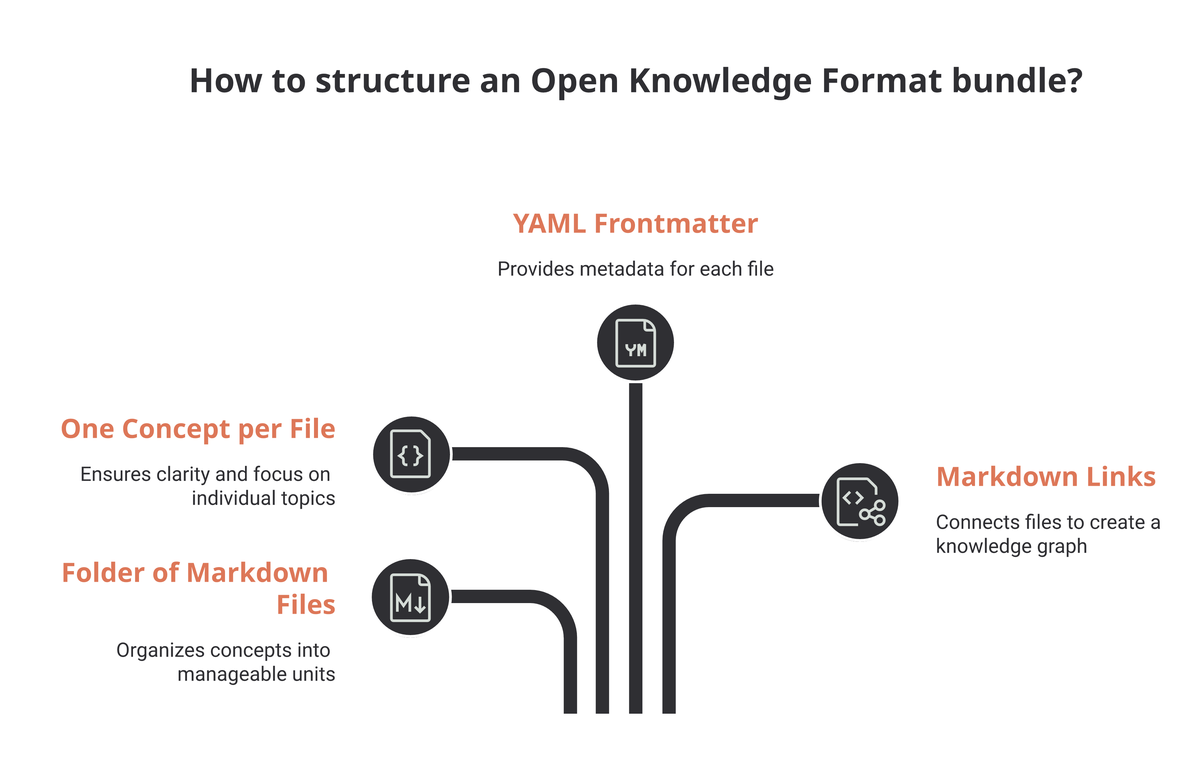
Two facts keep it honest. First, it’s v0.1 and explicitly a draft — Google calls it “a starting point, not a finished standard.” Second, the target is internal company knowledge — the context “locked behind whichever surface created it,” the schemas and metric definitions and tribal knowledge that today live scattered across wikis, data catalogs, and a few senior engineers’ heads. The problem OKF solves is an AI agent inside your company can’t assemble a reliable answer because the knowledge is siloed. It’s the productized version of Andrej Karpathy’s “LLM wiki” idea from earlier this year, not a publishing spec.
What it is not
It is not a ranking signal. It is not a public-web format. It is not something Google asked website owners to adopt, and there is — as of v0.1 — no evidence any search or answer engine reads an OKF bundle off your domain to decide anything. Anyone already selling “OKF optimization” or an “OKF audit” is selling the same vapor as the people who promised a magic llms.txt cheat code — the part of every new-format cycle that didn’t survive contact with Google’s own guidance last time and won’t this time either.
This matters because the reflex in our corner of the industry is to treat every Google announcement as a homework assignment. OKF is not your homework. If you do nothing about it, your traffic will be exactly the same next quarter.
Why a solo publisher should still care
Here’s the part that is worth your attention. OKF is Google formally blessing a pattern: one concept per file, structured metadata on top, plain explanation underneath, everything cross-linked into a graph, all in plain markdown a machine can read without a parser. That is not a new idea to anyone who has been doing answer-engine optimization — it’s a near-exact description of what already gets a page cited by ChatGPT and Perplexity: self-contained sections that answer one question, front-loaded, cleanly linked, machine-readable.
OKF is the internal-knowledge cousin of what GEO asks you to do on the public web. Same shape, different surface. When the company that runs the index ships an internal standard whose core moves are “atomic concepts, structured front-matter, link them into a graph, keep it as plain markdown,” that’s a strong tell about how the people building the agents think knowledge should be shaped for machines to consume — and your public content is consumed by the same class of machines.
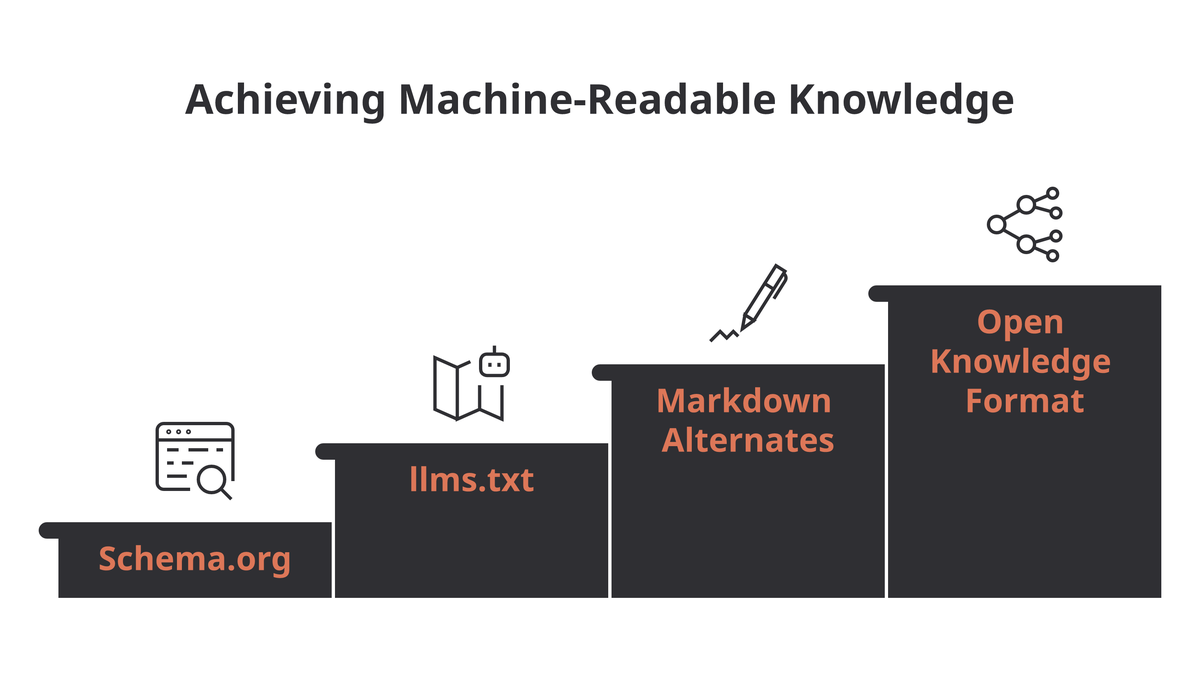
llms.txt, to clean markdown versions of pages, to a linked markdown knowledge graph. The throughline never changes: structure your knowledge so a machine can read it without guessing.What to actually do Monday morning
- Don’t “implement OKF” on your site. There’s nothing to implement and no one reading it. Ignore the audits.
- Steal the structure, not the spec. The transferable lesson is free and it’s plain good GEO: write in atomic, self-contained concepts — one idea per page or section, the answer up top, generous internal links so your site reads as a connected graph and not a pile of disconnected posts. That’s the context-density habit wearing a new name.
- Run the cheap experiment if you’re curious. You already may publish markdown alternates and an
llms.txt; an OKF-style bundle of your own site (a folder of linked markdown concept files with frontmatter) is a small step further and a genuinely interesting one to test as agents start consuming structured knowledge. Treat it as an experiment with possible early-mover upside, not a chore — and measure whether anything actually reads it before you invest more. The reference implementations and sample bundles are on GitHub. - Watch the boundary. The thing to actually monitor is whether OKF’s conventions creep from “internal agent context” toward “how public content gets ingested by agents.” If that bleed happens, the publishers already writing clean, atomic, interlinked knowledge won’t have to change anything.
The bottom line
OKF is not a new SEO task, and the loudest takes about it are wrong in the usual direction — turning an internal data-sharing format into a must-do ranking ritual. The signal isn’t “add a file.” The signal is confirmation of the trajectory: knowledge is being restructured, deliberately and by the biggest player in the room, so machines can read it cleanly. That’s the same bet the AI Search · GEO channel has been making all along — the work that earns a citation and the work that makes good internal agent-knowledge are converging on one shape, and the solo publishers who already write that way are quietly positioned for whatever the next format turns out to be.
Sources: Google Cloud, “How the Open Knowledge Format can improve data sharing” (June 12, 2026); Search Engine Journal and MarkTechPost coverage of the OKF v0.1 announcement; practitioner experiments applying OKF to public sites. Related reading on RankingHacks: What GEO actually is, How to get cited by ChatGPT & Perplexity, and the context-density framework.