Google Search at I/O 2026: The Affiliate Squeeze Tightens
Google's I/O 2026 Search announcement landed on May 19. Behind the marketing copy: information agents, agentic booking, generative UI, and personalized synthesis — each one a direct hit on a specific affiliate-marketing playbook. Here's the line-by-line read for solo publishers.
Elizabeth Reid, VP of Search at Google, published A new era for AI Search on May 19, 2026. The post bundles five product announcements under one banner: Gemini 3.5 Flash as the default AI Mode model, a redesigned conversational Search box, Information Agents, Agentic Booking, Agentic Coding in Search (generative UI), and an expansion of Personal Intelligence to 200 countries and 98 languages.
Read it once for the product news. Read it twice and a pattern emerges: each launch deliberately removes a friction point that an affiliate publisher used to charge for. The comparison post. The newsletter alert. The buying calculator. The decision wizard. Each of those is something an affiliate site built audiences around. Each of them just got a Google-shipped replacement.
This isn’t an extinction event. It’s a category-by-category compression of the surface where affiliate revenue lives. The publishers who keep earning will be the ones who can articulate, in one sentence, what their site does that Google can no longer synthesize.
What Got Announced, Line by Line
| Announcement | What it does | Affiliate-side implication |
|---|---|---|
| Gemini 3.5 Flash in AI Mode | New default model, worldwide, today | Faster + cheaper AI Overviews. More queries answered without a click. |
| Conversational Search box | Multimodal input, sustained context, follow-ups from AI Overviews | The browsing session collapses into a single Search conversation. Multi-page comparison journeys shrink. |
| Information Agents | 24/7 background agents that scan blogs/news/social for the user, send synthesized updates | Replaces the “subscribe to my newsletter for deal alerts” playbook. |
| Agentic Booking | Direct booking links + Google-makes-the-call for local services | Routes around comparison-post affiliate revenue for bookable categories. |
| Agentic Coding / Generative UI | Search builds custom dashboards, trackers, comparison interfaces on the fly | Replaces buying calculators, comparison tools, and decision wizards. |
| Personal Intelligence (200 countries, 98 languages) | Uses Gmail / Photos / Calendar context to personalize answers | Generic “best X for everyone” posts lose relative to context-aware Search output. |
Rollouts vary. Gemini 3.5 Flash in AI Mode and the new Search box are live today globally. Information Agents and the U.S. agentic booking expansion land summer 2026, with Information Agents gated to Google AI Pro and Ultra subscribers. Generative UI for everyone arrives in the coming months. Personal Intelligence at the new scope is available now and free.
The Five Specific Affiliate Playbooks Under Pressure
It’s worth being concrete. A vague “AI changes everything” frame is useless to a working affiliate publisher. Here are the specific revenue patterns these announcements compress, and the ones they don’t.
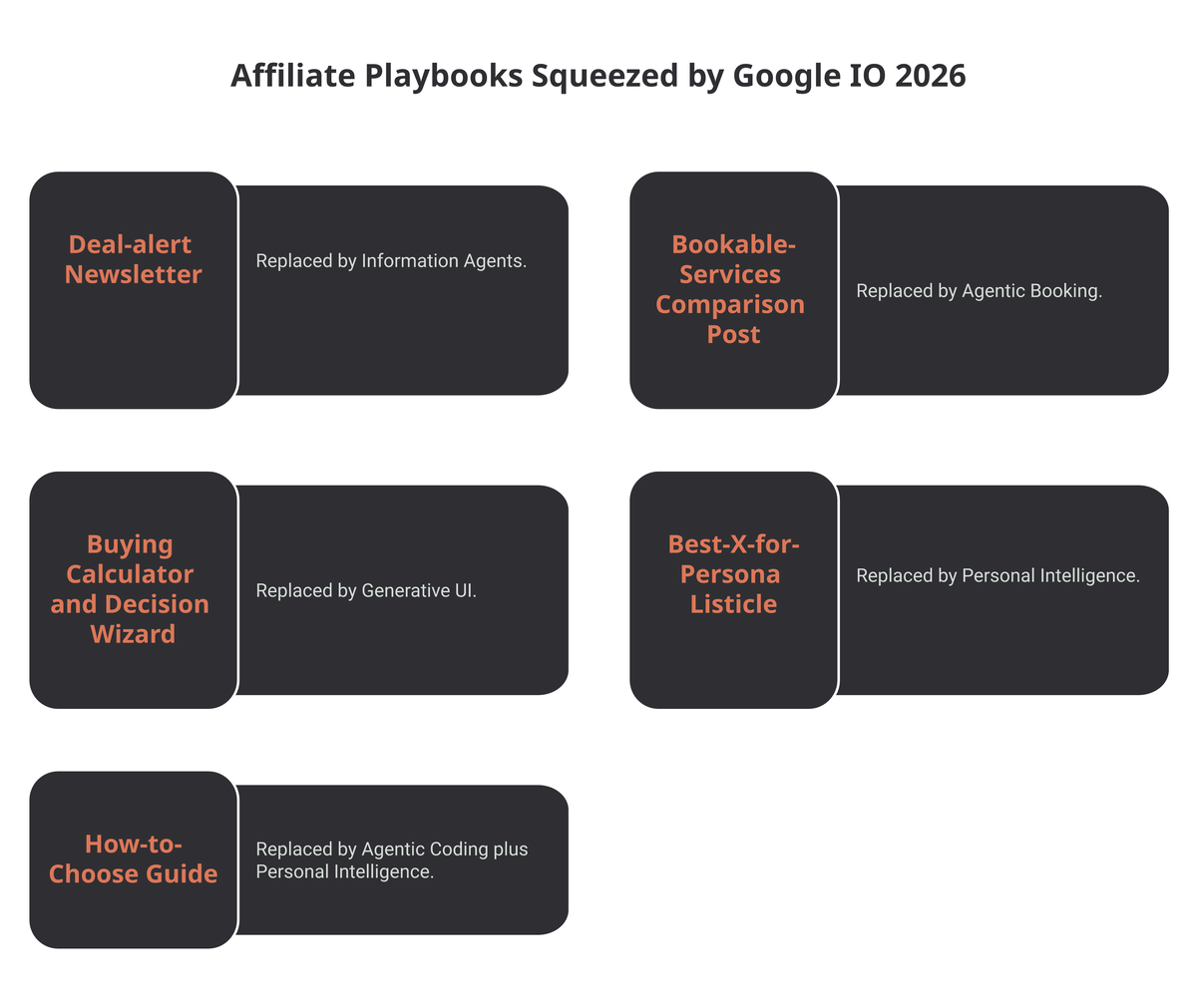
1. The deal-alert newsletter
The pattern: build an email list around “we tell you when sneaker drops happen / when this camera goes on sale / when these GPU prices fall.” Monetize via affiliate links in the alert.
What Information Agents does: “We tell you when sneaker drops happen,” but it’s Google running the agent on Google’s data, and the alert lands in the user’s chosen surface (Discover, Now Playing, Assistant) with direct links to the source. The publisher cut-out is implicit. The example in the I/O post is literally “alerts you to when your favorite athlete announces their next collab.” Identical to a deal-alert newsletter’s reason to exist.
What survives: deal-alert newsletters with proprietary data the agent can’t see — invite-only drops, manufacturer-direct early access, broker relationships, restocks tracked through purchasing-system back-channels rather than public listings.
2. The bookable-services comparison post
The pattern: “Best date-night restaurants in Berlin” — outbound to OpenTable / Resy / SevenRooms with an affiliate ID.
What Agentic Booking does: Google compiles availability and pricing across providers and links “directly to finish booking through the provider of your choice.” For home repair, beauty, and pet care, Google literally calls the business for the user. Both flows skip whatever affiliate layer the comparison post inserted.
What survives: niches where Google’s compiled data is thin (long-tail venues, members-only clubs, niche communities), or content where the recommendation itself — not the booking handoff — is the value, AND the publisher has built enough brand that users come to them before Search.
3. The buying calculator / comparison tool / decision wizard
The pattern: a hand-built calculator (“Find your perfect lens”), interactive comparison table, or decision-tree wizard. These rank in Search and drive affiliate clicks because they convert higher than prose.
What Agentic Coding does: from the I/O post — “Ask Search to build you a custom fitness tracker. Search will code it for you, tapping into fresh, real-time sources including reviews, live maps and local data.” The mini-app pattern is explicitly aimed at “ongoing tasks like planning a wedding or managing a home move.” Wedding planning. Home move. Two affiliate categories with major calculator-and-checklist content footprints.
What survives: calculators where the inputs are NOT visible to Google (your customer’s internal data, proprietary scoring algorithms, paid-API live data), or where the answer requires editorial judgment the model can’t replicate (e.g. tax strategy, legal nuance — categories Google rightly stays away from).
4. The “best X for [persona]” listicle
The pattern: “Best mirrorless camera for landscape photography.” Personalized just enough by persona to be useful, generic enough to rank.
What Personal Intelligence does: when Search has access to the user’s Gmail (what they’ve bought, what newsletters they read), Photos (what they actually shoot), and Calendar (the trip they’re packing for), the answer composed for them is more personalized than any listicle. Generic-persona content stops being differentiated.
What survives: content built around expertise the model can’t synthesize from index text — long-duration testing notes, repeat-purchase analysis, real photo samples, lab measurements, breakdown of failure modes encountered over months of use. The kind of thing Derek Hales describes building affiliate review sites around — real testing, real photos, real opinion. Generic listicles compress; serious review work doesn’t.
5. The “how to choose” educational guide
The pattern: explain a complex purchase decision (refinancing, solar panels, mattresses) over 4,000 words, with affiliate links to providers in the final third.
What Agentic Coding + Personal Intelligence does together: build a custom decision tool calibrated to the user’s actual situation, with Search choosing which providers to surface based on context. The educational layer collapses into the same response as the recommendation layer.
What survives: guides written by people who can demonstrate they actually went through the decision, with documentation, receipts, and follow-up data. Trust-driven content beats educational-driven content when the educational layer is a commodity.
What the Announcement Doesn’t Cover (And Why It Matters)
Reading what Google doesn’t say is as important as what it does. The blog post is silent on three things every affiliate publisher needs answers to:
-
Citation policy in the new Search box. The post says users get “a range of results from Search, just like you do today.” It doesn’t quantify how often citations appear in conversational follow-ups, how prominent they are, or how the new Search box ranks attribution against synthesis. The recent Google AI Optimization Guide was equally vague — “keep doing SEO, your content surfaces” — but didn’t give measurable surfaces.
-
Agent attribution model. When an Information Agent reads your blog post and sends the user a synthesized update, does that count as a Search referral in any analytics surface? Does the user see a link back? Today: unknown. This matters because if Information Agents read affiliate content and never send clicks, the work is unfunded.
-
Shopping agent specifics. The I/O post refers to “new agentic capabilities in Shopping” but pushes the detail to a separate blog. The shopping side is where most affiliate revenue lives. Whatever Google does in shopping with agents is the single highest-impact decision for affiliate publishers this year, and it wasn’t in the headline announcement.
The honest read on the silence: Google isn’t going to publish “here’s how much we’ll cite you in the new conversational mode” because it would create a gameable surface. But the absence of clarity means publishers are pricing risk without information.
What to Do This Week
For a solo publisher reading this on a Thursday morning, the working response splits into “stop” and “start.”
Stop:
- Stop expanding generic “best X for everyone” listicle inventory. That category is being compressed, not expanded.
- Stop building calculators and decision wizards as your primary differentiation. Generative UI will replicate them.
- Stop assuming Google referral traffic on bookable-services posts will hold. It won’t.
Start:
- Start building proprietary data moats — original testing logs, primary interviews, real photo samples, before/after measurements. Anything Search can’t synthesize from index text.
- Start migrating attention to owned audience — newsletters, YouTube, paid communities. Owned audiences are agent-resistant in the sense that the agent doesn’t intermediate them.
- Start picking categories where personal context is noisy — wedding photographers (extremely personal but not encoded in Gmail), trade tools (depends on physical needs Search doesn’t see), serious-hobby gear (depends on experience level Search doesn’t measure).
- Start watching the Chrome WebMCP trajectory. It’s the active-agent counterpart to the passive personalization Search just announced — a page that registers tools wins agent invocations the same way a page with proprietary data wins citations.
The frame: the value of being indexed by Google is dropping for generic content and holding for expertise-driven content. The squeeze is asymmetric. Which side of that line your site sits on matters more than any individual update.
A Note on the Coverage Pattern
It’s now three Google announcements in roughly four weeks that all touch the agent layer: the AI Optimization Guide on May 15, Chrome’s WebMCP on May 18, and the I/O 2026 Search post on May 19. Two-week cadence, three different surfaces, one coordinated story: AI agents are the layer where the next two years of Search velocity sit, and Google is broadcasting the direction loudly enough that publishers who want to argue with the framing have run out of plausible deniability.
The framework RH has been pushing for months — focus on what AI can’t synthesize, build owned channels, accept that generic listicle content is in structural decline — holds up against this announcement. Nothing in the I/O post invalidates the operational checklist. It just adds urgency to it.
Sources: Elizabeth Reid, “A new era for AI Search”, Google Blog, May 19, 2026. Related reading on RankingHacks: Google’s AI Optimization Guide, Chrome’s WebMCP, Adapting to AI Search, Affiliate Review Sites with Derek Hales, LLM-Driven SEO.