SEO Strategy and Portfolio Management: Lessons from Professional Poker
In a revealing presentation at the Chiang Mai SEO conference, Koen Bongers, who manages six high-value websites across 15 languages generating over 70 million in revenue, shared insights on applying poker strategy principles to SEO. This analysis examines how probability-based decision making and po

In a revealing presentation at the Chiang Mai SEO conference, Koen Bongers, who manages six high-value websites across 15 languages generating over 70 million in revenue, shared insights on applying poker strategy principles to SEO. This analysis examines how probability-based decision making and portfolio management can enhance SEO outcomes.
The Data-Driven Foundation
Bongers’ approach is backed by significant results:
- Management of 6 websites across 15 languages
- Revenue growth from 150K to 7M+ monthly
- Portfolio spanning crypto, government, technology, and investing verticals
- Team growth from 2 to 170+ people in 18 months
Core Strategic Principles
Expected Value in SEO Decision Making
SEO professionals often make decisions without calculating potential returns. Bongers introduces the concept of Expected Value (EV) from poker:
EV = (Probability of Success × Potential Gain) - (Probability of Failure × Potential Loss)This framework helps evaluate:
- Market entry decisions
- Content investment choices
- Resource allocation
- Risk assessment for different SEO tactics
Page Updates vs. New Content
A critical finding from Bongers’ data shows stronger correlation between page updates and performance than new content creation. Key observations:
- Performance Correlation
- Strong positive correlation between update frequency and page performance
- Pattern holds true at page, subfolder, language, and domain levels
- Update Frequency Rule
- Minimum: Annual updates for evergreen content
- Recommendation: Don’t create pages you can’t maintain
- Focus: Prioritize updating existing content over creating new pages
Competitive Advantage Analysis
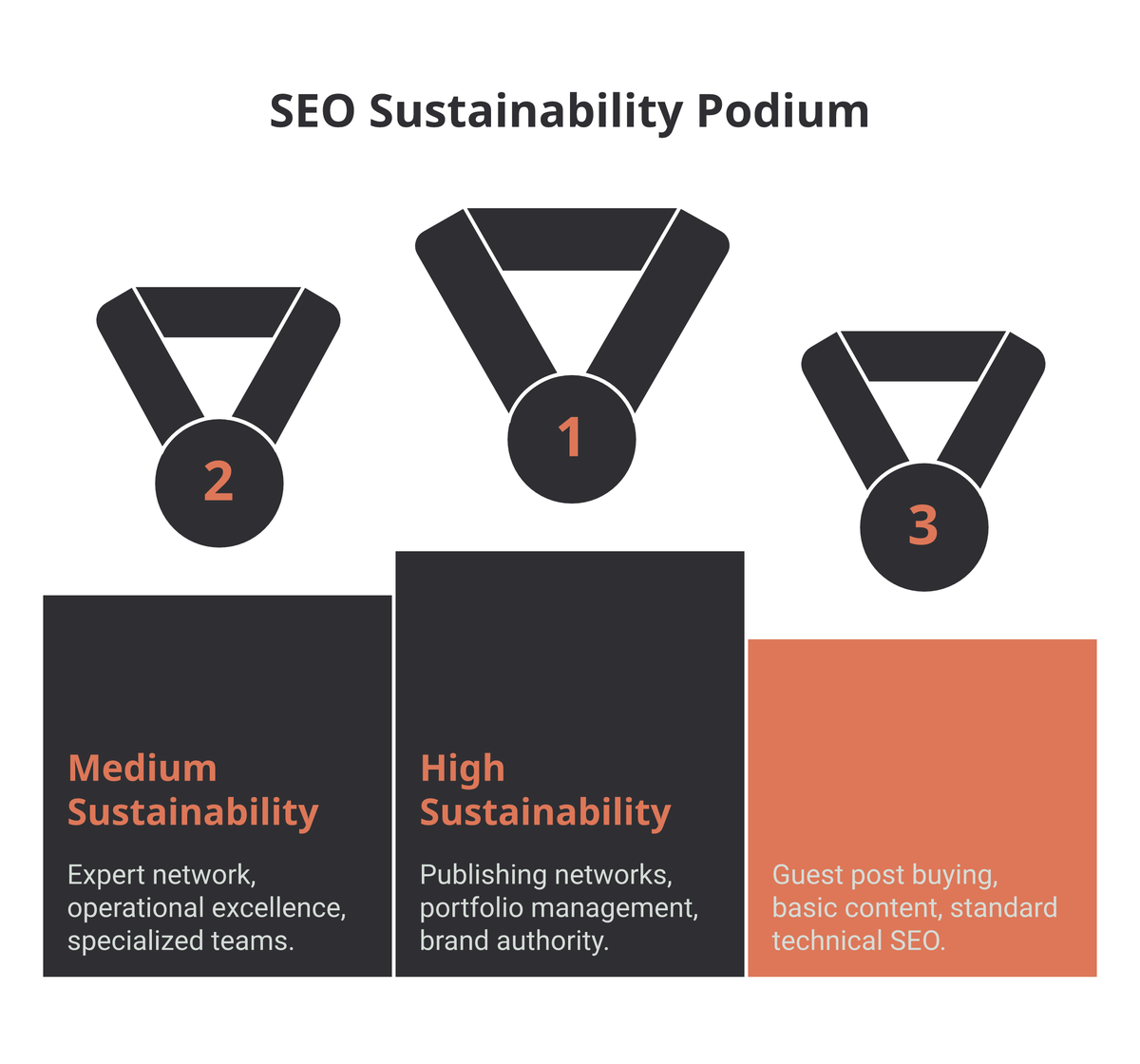
Bongers presents a framework for evaluating competitive advantages using three criteria:
- Value: Does it provide meaningful differentiation?
- Rarity: How many competitors can replicate it?
- Inimitability: How difficult is it to copy?
Examples ranked by sustainability:
Low Sustainability:
- Guest post buying
- Basic content creation
- Standard technical SEO
Medium Sustainability:
- Subject matter expert network
- Operational excellence
- Specialized content teams
High Sustainability:
- Large publishing networks
- Portfolio domain management
- Brand authority
Portfolio Management Strategy
Bongers reveals a tiered approach to domain management:
Conservative Approaches
- Brand building
- Product-focused SEO
- Direct traffic development
Moderate Risk
- High-authority domain acquisition
- Network link building
- Professional content development
Aggressive Tactics
- Exact match domains
- AI-generated content
- Social platform optimization
Practical Implementation Framework
- Time Management Optimization
- Automate repetitive tasks
- Create comprehensive dashboards
- Implement efficient project management
- Set up automated reporting systems
- Resource Allocation
- Focus on high-EV projects
- Scale through delegation
- Build trusted teams
- Maintain operational flexibility
- Risk Management
- Diversify SEO strategies
- Balance aggressive and conservative tactics
- Monitor algorithm changes
- Maintain multiple traffic sources
My Take: What This Means for Solo Publishers
Koen Bongers built a 170-person team across six sites and generated over $70M in revenue. That’s not you — but his poker framework translates almost perfectly to the solo publisher scale, maybe even better.
The EV formula is the real takeaway. Most solo operators make content decisions based on gut feel or what their keyword tool says is “possible.” Bongers is saying: assign probabilities. If you’re deciding whether to go after a keyword cluster or buy an aged domain, run the math. What’s the realistic win probability? What’s the downside if you’re wrong? That discipline separates people who grind for three years and plateau from those who actually build compounding portfolios.
The update-over-create finding is something I’ve been sitting on for a while. For solo publishers, this is actually liberating — you don’t need to keep producing new pages. The data says your existing pages, refreshed regularly, will outperform new content. If you want a systematic approach to this, the content reoptimization framework covered here is the best starting point.
What’s changed since Koen’s Chiang Mai presentation is the addition of a new risk layer: AI search. Current data from 2025–2026 shows LLM citation rates becoming a real traffic driver alongside traditional Google rankings. Your SEO portfolio now needs to account for both. That makes diversifying traffic sources beyond standard organic more urgent than it was even two years ago. A portfolio of two or three sites with genuine topical authority beats ten thin sites in this environment.
The sustainability framework — low, medium, high — maps well to where you should actually spend time as an affiliate publisher. Guest post buying and basic content are commoditized. The sustainable edges are data-driven content depth and topical authority built over time. If you’re playing the long game, building and selling digital assets is the logical endgame — and it requires the same portfolio discipline Bongers describes.
One thing worth pushing back on: Bongers lists AI-generated content as a high-risk aggressive tactic. That’s fair for bulk content factories. But selectively using AI to scale updates on existing pages — not to churn out new content — is a different variable entirely. Peter Macinkovic’s affiliate SEO framework makes the same point: use AI as an efficiency multiplier for maintenance, not a volume hack for acquisition.
Action Items
- Audit Current Portfolio
- Document all domains and their purposes
- Assess current update frequencies
- Evaluate resource allocation
- Map competitive advantages
- Implement Tracking Systems
- Set up automated dashboards
- Create update frequency monitors
- Track page-level performance
- Monitor competitor movements
- Optimize Resource Distribution
- Calculate EV for current projects
- Identify automation opportunities
- Document repetitive tasks
- Plan delegation structure
- Build Competitive Advantages
- Identify sustainable differentiators
- Develop unique assets
- Create barriers to entry
- Build scalable processes
- Risk Management Implementation
- Balance portfolio risk levels
- Create recovery procedures
- Document contingency plans
- Set risk tolerance thresholds
Summary
Bongers’ approach demonstrates that successful SEO requires systematic thinking, probability-based decision making, and strategic portfolio management. The key to sustainable growth lies not in individual tactics but in building systems that create lasting competitive advantages while managing risk effectively.
The implementation of these principles requires:
- Clear competitive advantage identification
- Systematic portfolio management
- Data-driven decision making
- Efficient resource allocation
- Balanced risk management
Organizations that adopt these frameworks position themselves for sustained success in SEO, moving beyond tactical execution to strategic portfolio management.
Sources: Koen Bongers’ portfolio management and poker strategy presentation, Chiang Mai SEO Conference. Related reading on RankingHacks: Building and Selling Digital Assets, Data-Driven SEO Content Strategy.