
The E-commerce SEO Recovery Case Study
Summary
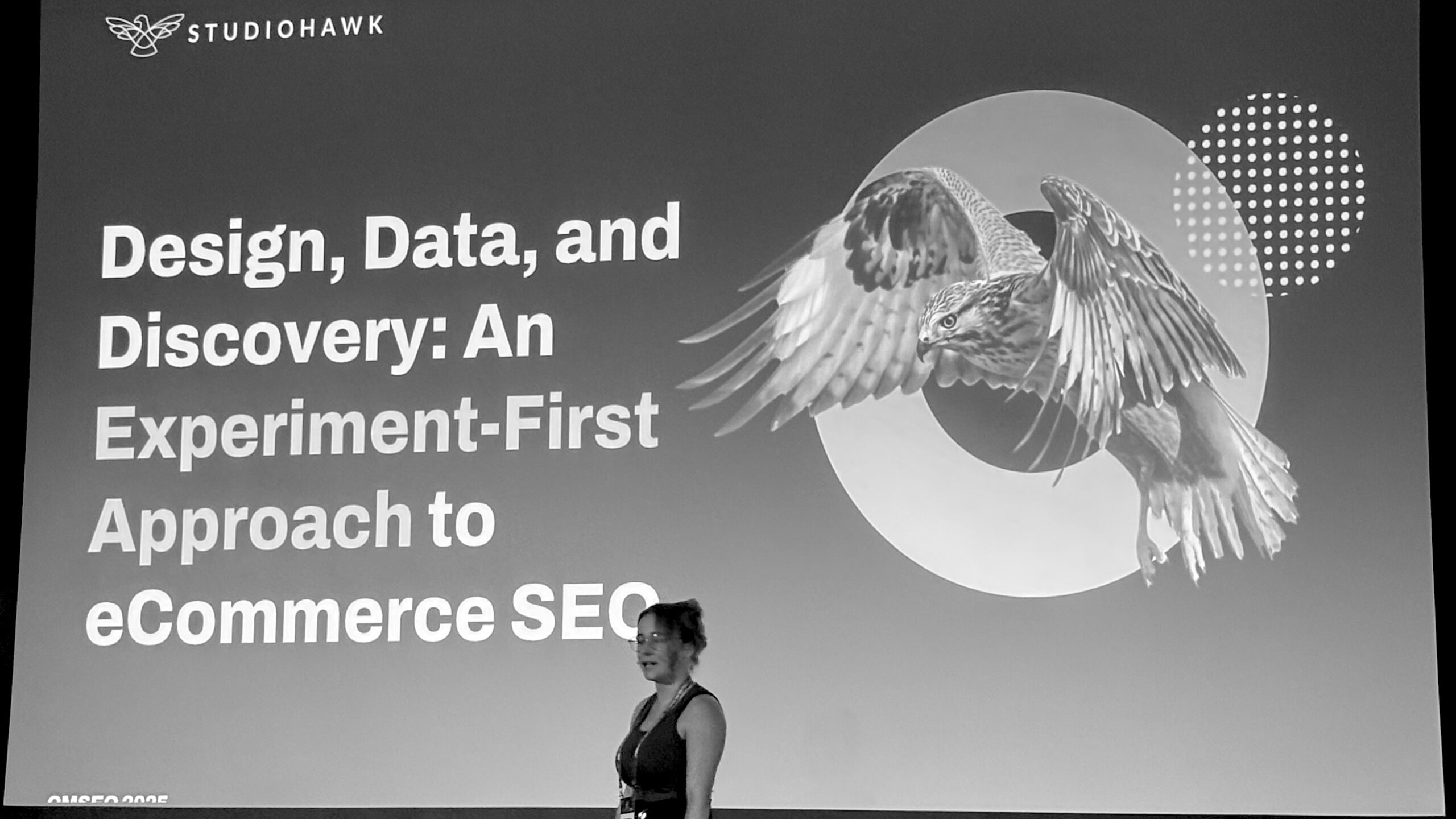
The following is a case study on A/B testing and e-commerce SEO for a custom apparel company, based on the experience of the co-founder and director of StudioHawk, Sophie Brannon. The presentation detailed how traditional SEO best practices failed to improve rankings for the company’s main revenue-driving keyword, “custom t-shirts,” and how a radical UX-focused approach ultimately resolved the problem. The core lesson was that in evolving SERP landscapes, a user-centric design strategy can override standard on-page SEO content tactics.
The Core Problem at Rush Water Tees
- Background: The company was hit hard by a significant Google algorithm update in December 2022.
- Initial Failure: Despite implementing basic SEO “best practices” (e.g., page title changes, site speed optimizations, keyword insertions), rankings for the critical “custom t-shirts” keyword dropped from mid-page one to mid-page two.
- Critical Impact: This keyword was essential, accounting for over 80% of the company’s revenue, making the ranking decline a major business crisis.
- Puzzling Context: While the t-shirts category declined, other key categories (like custom hoodies and hats) remained resilient, suggesting the issue was highly specific to the core product page.
Misguided SEO Approaches and The ‘Midlife Crisis’
The director detailed a period of intense, yet ineffective, traditional SEO efforts:
- Content Overload: Adding extensive buying guide content to the category pages.
- Technical & Linking Fixes: Improving internal linking, fixing page speed, and focusing link acquisition exclusively on the t-shirts page.
- Title Tweaking: Repeatedly adjusting page titles and content.
Key Discovery: Research contradicted the “more content is better” belief. Top-ranking e-commerce category pages averaged only ~310 words of content, suggesting the content-heavy approach was counterproductive.
SERP Analysis & The UX Hypothesis
Analysis of the search results and competitors revealed a shift in the ranking strategy:
- Evolving SERP: Search results were dominated by mixed intent (category pages, forums, guides) and an increase in features like “Things to know,” “Explore brands,” and organic shopping listings, which limited the visibility of traditional organic links.
- Competitor Benchmarks:
- Custom Ink: The market “gorilla” whose layout was similar to the company’s struggling legacy page.
- Vistaprint: Featured a cleaner layout, better imagery, internal linking widgets, and visible pricing.
- Uber Prints: Excelled with a well-designed “How It Works” section and effective use of TrustPilot reviews.
- The New Strategy: Based on this data, the team hypothesized that User Experience (UX) was the key issue. A solution was developed to address mixed search intent and the distinct customer journey (B2B and B2C), though internal bureaucracy and a CMS migration significantly delayed the launch.
The A/B Test and Immediate Results
The Test
- Timeline: The solution process stretched from Q4 2023 to the A/B test launch in Q1 2025.
- Design: A new Product Listing Page (PLP) was developed, inspired by Vistaprint, featuring a cleaner layout, better imagery, and improved navigation for a streamlined user experience.
- Measurement: Due to testing limitations, the team tracked engagement and conversion KPIs, not direct SEO metrics, using Optimizely.
| Metric Tracked | Result |
| Revenue Per Visitor (RPV) | +26% increase |
| Visit Design Studio Rate | +3% increase |
| Save Design Rate | +2.5% increase |
| Bounce Rate | -3.5% reduction (reached statistical significance) |
Technical Fixes and SEO Recovery
During implementation, a critical technical issue was discovered: a Next.js change that rendered key content (like FAQs) client-side, making it unreadable to Google. After fixing this rendering issue and implementing the winning UX design:
- Rapid Ranking Jump: The “custom t-shirts” keyword rebounded from position 12 to position 5 within weeks.
Future-Proofing and Key Learnings
To sustain and grow organic visibility, additional strategies were implemented:
- Authority Building: Adding expert advice content and running Digital PR campaigns for brand mentions and site authority.
- Engagement Tools: Launching an AI design wizard tool.
- Shopping Optimization: Optimizing for organic shopping listings (schema, naming conventions, improved imagery).
- Site Search: Improving site search functionality with Algolia.
- Internal Linking: Implementing internal linking widgets for better information architecture.
Conclusion
The key takeaways from the successful recovery were:
- Best Practices Are Not Universal: Standard SEO tactics fail when not tailored to the industry’s specific nuances and customer journey.
- SERPs Are Evolving: Strategy must account for the increase in SERP features, which require diversifying presence beyond just the “ten blue links.”
- Testing is Vital: While avoiding over-testing small changes, testing significant redesigns is crucial to understand the full impact across all channels and ensure a strong, conversion-focused User Experience.
Action Items for E-commerce Teams
- Analyze SERPs for mixed search intent and shifting features before any major redesign.
- Invest in navigation improvements as a high-impact UX change for both users and internal link equity.
- Implement an internal linking widget to improve user flow and information architecture.
- Focus on getting feedback from fresh eyes (people unfamiliar with the website) to uncover overlooked UX issues.
- Utilize Digital PR to boost brand mentions and visibility for E-E-A-T and LLM integration.