Unlocking the Potential of AI in SEO and Marketing: A Comprehensive Guide
TL;DR: The Easy Summary This article talks about how Artificial Intelligence (AI) is changing the game in the world of online search and marketing. Here are the main points it covers: The bottom line is, AI is making it easier for businesses to create stuff online that people really want to see or r

TL;DR: The Easy Summary
This article talks about how Artificial Intelligence (AI) is changing the game in the world of online search and marketing.
Here are the main points it covers:
- AI Helps Make Better Web Content: It can write a lot of articles or content that is just what people are looking for. This means websites can have lots of pages that attract visitors because the content is super relevant to what they’re searching for.
- AI Makes Finding Leads Easier: By using AI, websites can have chatbots and other cool tools that make it easier for visitors to find what they want or sign up for something. This is better than just filling out boring forms and makes more people interested.
- AI Understands What Customers Want: By listening to what people say on sales calls (with the help of AI), companies can figure out what their customers are really looking for. Then, they can write articles or create content that answers those needs, which makes customers more likely to buy or sign up.
The bottom line is, AI is making it easier for businesses to create stuff online that people really want to see or read. This not only makes customers happy but also helps businesses grow by attracting more visitors to their websites.
In the digital age, Artificial Intelligence (AI) has emerged as a revolutionary force, transforming industries and redefining strategies. The realms of Search Engine Optimization (SEO) and marketing are no exception, with AI paving the way for innovative approaches that enhance visibility, engagement, and conversion rates.
This blog post delves into the effective applications of AI in SEO and marketing, drawing insights from a detailed presentation by Kevin Indig that outlines three pivotal use cases:
- generating optimized, data-driven content at scale;
- building enhanced lead generation tools with better user experiences (UX); and
- deriving unique customer insights from sales call transcripts to create more relevant content.
Let’s explore these transformative strategies and their significant impact on the industry.
Programmatic SEO Content with AI
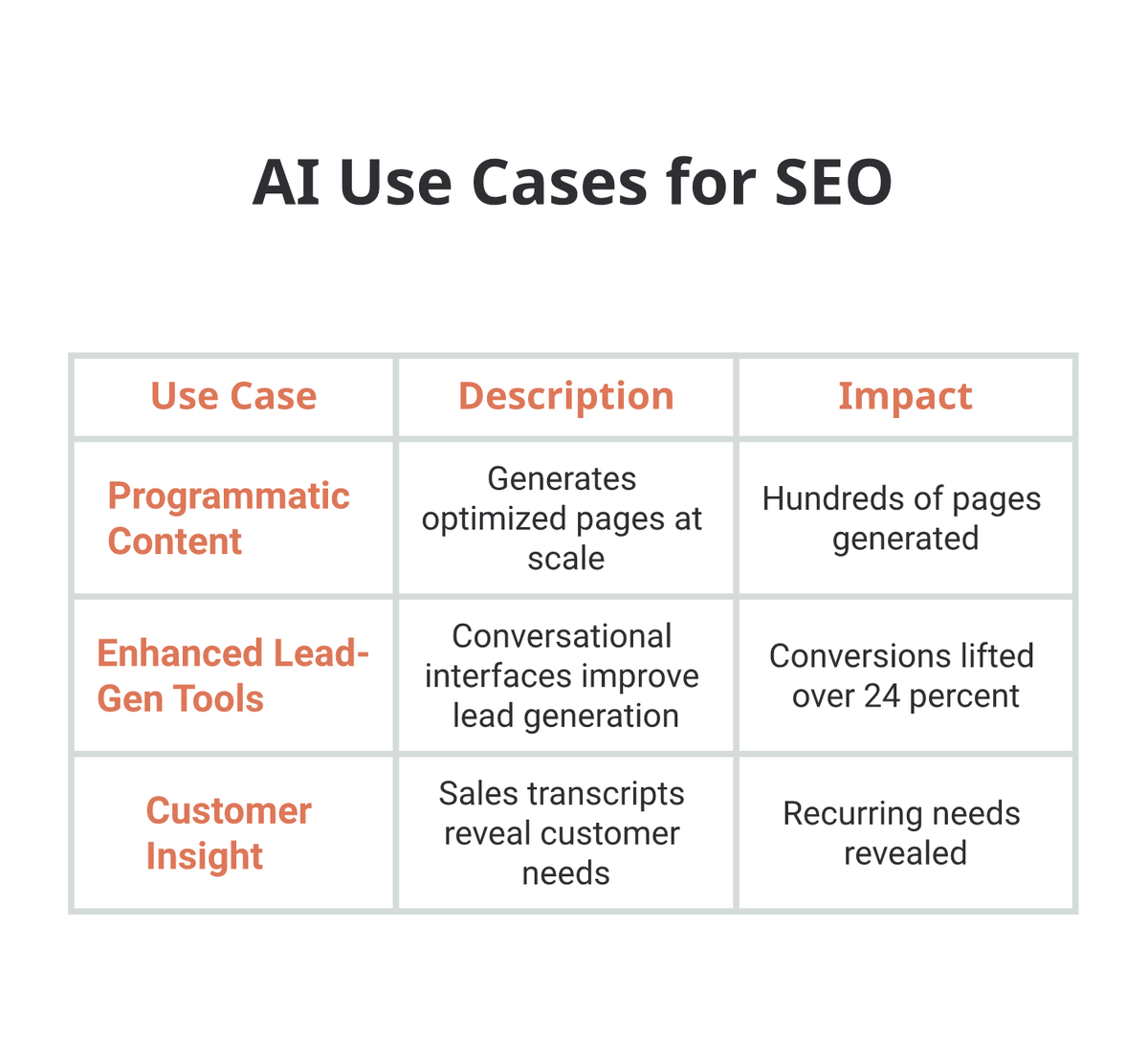
One of the most compelling applications of AI in SEO is the creation of programmatic content tailored to specific needs and locations. By feeding AI systems detailed data prompts, including persona, style guide, output format, and specific content requirements, marketers can automate the production of hundreds of optimized pages. These pages, focusing on high-intent topics such as hourly wage jobs, drive significant traffic and contribute to pipeline growth. A meticulously crafted 400+ word prompt resulted in the generation of valuable content, demonstrating the AI’s capability to produce high-quality, targeted material at scale. This approach not only saves time but also ensures consistency and relevance, catering to the specific interests of the audience.
Enhanced Lead Generation Tools
The use of AI extends beyond content creation to the enhancement of lead generation tools. By incorporating conversational interfaces into calculators and other tools, such as job description generators, AI significantly improves the user experience over traditional forms or text inputs. These advanced interfaces can be seamlessly integrated across website pages, leading to a substantial increase in conversions. The success of such tools is evident, with one project reporting a more than 24% increase in conversion rates, underscoring the effectiveness of AI in engaging users and encouraging them to take action.
Customer Insight for Relevant Content
Another remarkable benefit of AI in marketing is its ability to extract unique customer insights from sales call transcripts. Analyzing these transcripts helps identify recurring problems and needs among prospects, providing a goldmine of information for content creation. Addressing these insights in blog content has led to exceptionally high conversion rates, highlighting the value of tailoring content to the specific challenges and interests of the audience. This strategy not only enhances the relevance of the content but also fosters a deeper connection with the audience, encouraging engagement and conversion.
My Take: What This Means for Solo Publishers
The three strategies Kevin covers here are enterprise plays dressed up as universal advice — and solo publishers need to filter which parts actually apply at their scale.
On programmatic SEO with AI: This works at the solo level, but the implementation looks different. You’re not spinning up 400+ pages with a staffed prompt engineering team. You’re identifying a tight keyword cluster — 20–30 location-specific or comparison pages — and using a well-crafted prompt to generate first drafts you then edit for voice and accuracy. The full mechanics are covered in Programmatic SEO Using AI — but the core takeaway is that quality control is the bottleneck, not content generation itself.
On lead generation tools: Most affiliates don’t have dev resources to build custom conversational calculators. The underlying principle is what matters: reduce friction at the decision point. A structured comparison table or a simple self-selection quiz captures most of the benefit. The 24% conversion lift cited here comes from removing form friction, not from the AI layer itself.
What actually matters in 2026: The bigger shift, which this presentation predates, is AI Overviews. As of early 2026, AI-generated answers appear in roughly 48% of all search queries — up dramatically from a year ago. Your content doesn’t just need to rank; it needs to be extraction-friendly. Research on what gets cited points to passages of 134–167 words with specific, source-attributed statistics. For affiliate publishers, that changes how you structure content — shorter, denser sections with cited data outperform long narrative paragraphs. LLM-Driven SEO and the Context Density framework break down both angles in depth.
On mining customer insights: The sales-call transcript approach is enterprise territory. The solo equivalent is forum and community mining — Reddit, Quora, niche threads. Pull the questions your audience actually asks, not just what keyword tools surface. Adapting to AI search covers why understanding intent at this granular level is now table stakes for affiliate content that actually converts.
Bottom line for affiliates: Don’t skip the AI content playbook because it sounds like big-brand strategy. The ROI is real — 2–3% conversion rates from intent-matched content are achievable at solo scale. The limiting factor is usually content quality and topical depth, not production volume. And with AI Overviews reshaping how traffic flows, the affiliates investing in LLM visibility and AI chatbot optimization now will have a meaningful head start over those still optimising purely for ten blue links.
Key Takeaways and Action Items
The integration of AI into SEO and marketing strategies offers numerous advantages, from generating optimized content at scale to enhancing lead generation tools and uncovering valuable customer insights. Key takeaways include the importance of investing time in creating detailed prompts for AI, enhancing tools with conversational interfaces, using AI-generated content programmatically across sites, and conducting spot checks to ensure quality. The significant impact of these strategies is supported by impressive metrics, such as over 200,000 analyzed clicks from an AI SEO content project and conversion rates of 2-3% for AI-optimized content.
To further leverage the potential of AI in your marketing efforts, consider the following action items:
- Analyze academic articles in your field to identify key value words for specific journal or reader communities.
- Compare the effectiveness of writing focused on communicating your ideas versus changing audience thinking, tracking reader reactions.
- Research academic communities you are targeting for publications to deepen your understanding of their values, assumptions, and doubts.
- Aim to deliver reader-defined value, focusing on relevance and engagement rather than solely on originality or new knowledge.
Embracing AI in SEO and marketing not only streamlines operations and enhances efficiency but also unlocks new avenues for creating compelling, user-centric content. By strategically implementing AI-powered solutions, businesses can significantly improve their online presence, engage their target audience more effectively, and achieve remarkable growth in an increasingly competitive digital landscape.
Ideas and inputs: Kevin Indig, SEO Reborn Summit, 2024